








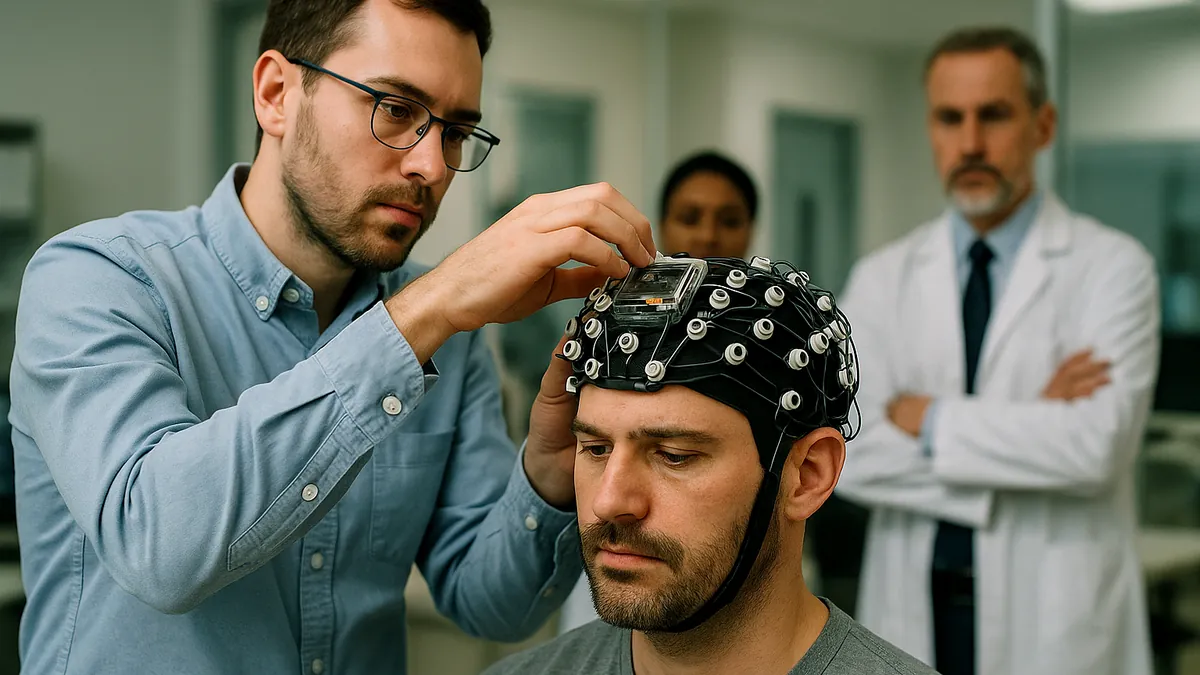
A new brain-computer interface result stands out for one specific reason: it did not just decode walking intent, it paired real-time exoskeleton control with bilateral sensory feedback on a portable embedded system. That makes it more relevant to rehabilitation engineering for paraplegic spinal cord injury patients than to the common narrative that exoskeleton BCIs are already close to simple, widely deployable products.
The advance is bidirectional control, not just brain-driven walking
The study used invasive subdural electrocorticogram electrodes implanted bilaterally in the interhemispheric leg areas of the primary motor and sensory cortices. That placement let the system do two jobs at once: decode intended leg movement in real time and deliver artificial leg sensation back to the brain.
That combination matters because earlier BCI-exoskeleton demonstrations often focused on one-way control. A user could issue commands, but the limb remained effectively insensate, which limits balance, gait adjustment, and confidence during walking. Here, restoring sensory input is part of the system design rather than an optional extra.
What actually changed compared with earlier exoskeleton BCIs
The practical difference is easier to see as a comparison between common assumptions and what this system actually demonstrated.

| Point of comparison | Common earlier pattern | This study |
|---|---|---|
| Signal source | Often non-leg areas or simpler command channels | Bilateral interhemispheric leg motor and sensory cortex targets |
| Control direction | Mostly unidirectional brain-to-device control | Bidirectional loop with movement decoding and sensory feedback |
| Compute setup | External processing or tethered hardware | Portable embedded platform for untethered operation |
| User value | Movement assistance without direct restored sensation | Movement plus artificial bilateral leg sensation |
| Deployment implication | Lab-bound demonstrations | Closer to mobile rehabilitation use, but still clinical and invasive |
The important correction is that this does not show non-invasive, ready-for-mass-use exoskeleton control. It shows that if you accept invasive electrodes in a difficult but relevant brain region, plus integrated embedded compute, you can build a more complete walking interface than systems that stop at command output alone.
The portable embedded system changes the deployment conversation
Running the full brain-exoskeleton interface on a dedicated portable embedded platform is a material engineering step. It removes the assumption that advanced decoding and sensory feedback must stay tied to bulky external hardware, which has been one of the reasons many BCI demonstrations remain confined to tightly managed lab settings.
Even so, portability is not the same as everyday deployability. A portable processor reduces wiring and room-scale infrastructure, but the overall care pathway still includes neurosurgery, exoskeleton fitting, calibration, support, and follow-up. In practice, that points first to specialized rehabilitation centers rather than home use at scale.
The main limit is the implant site, not whether the demo worked once
The interhemispheric implantation site is unusual, and that is part of why the result is notable. The leg areas of motor and sensory cortex are located in a region that is less commonly targeted than more accessible cortical surfaces, so surgical precision and risk management matter more here than they would in a simplified BCI narrative.
The study reports that implantation in this region was safe, which is an essential threshold, not a final answer. The next checkpoint is long-term clinical validation of bilateral interhemispheric implants under continuous use: whether signal quality stays stable, whether sensory feedback remains reliable, and whether extended exoskeleton control can be maintained without unacceptable complication rates.
Who this is for, and what would need to happen next
The target population is paraplegic patients with spinal cord injury, not general consumers and not necessarily every rehabilitation patient. Because the system depends on invasive electrodes and a custom integrated stack, access will likely be limited to patients who can undergo neurosurgical implantation and to institutions with the staff and infrastructure to maintain the full therapy pathway.
That creates a practical decision lens for the next phase. For clinicians and developers, the question is no longer just whether a patient can trigger exoskeleton steps from brain signals; it is whether bilateral sensory feedback improves functional walking enough to justify the added surgical complexity, device integration burden, and regulatory review required for an implanted medical system.
Regulators and hospital programs will also need evidence that goes beyond a breakthrough demonstration: durability of the implants, training time, maintenance load, adverse-event profile, and whether untethered operation on embedded hardware can hold up across repeated sessions outside a tightly controlled research environment.