






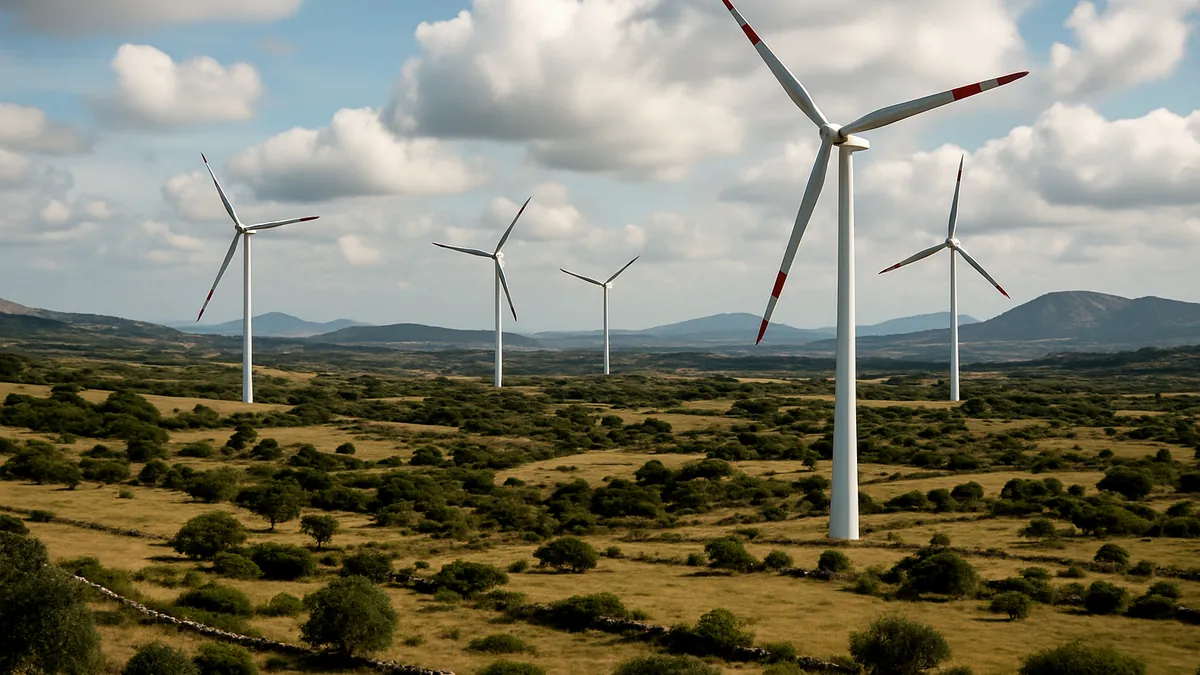
Sardinia’s energy problem is no longer resource scarcity. The island has strong wind and solar potential, its two coal plants are due to close by 2028, and a major new transmission link is on the way. The block is political and social: many Sardinians do not see large renewable projects as local decarbonization, but as another round of outside extraction dressed in green language.
Coal has a deadline, but renewable buildout is nowhere near ready
The immediate pressure point is timing. Sardinia still depends heavily on coal, with its two coal-fired plants scheduled to shut by 2028, yet renewable deployment remains far behind what that phase-out would require. The gap is visible in the grid pipeline: Terna, Italy’s transmission operator, received 804 requests for renewable grid connections in Sardinia totaling 54 GW, but only 0.4 GW has been approved so far.
That mismatch matters because connection requests are not the same as operating capacity, and approved capacity is what determines whether coal can actually be replaced. In practice, Sardinia is facing a sequencing problem: coal retirement has a date, but permitting, local consent, land access, and grid integration are all moving too slowly to guarantee replacement power at the same pace.
Why “NIMBY” is the wrong reading of Sardinian resistance

Reducing the backlash to visual impact or generic anti-wind sentiment misses the island’s specific history. Opposition has been shaped by centuries of outside control and by more recent industrial legacies, including the environmental damage associated with petrochemical development in the 1970s. That history changes the meaning of new energy projects. For many local communities, the question is not simply whether turbines or solar fields look acceptable, but who owns them, who profits, and who is left with the long-term costs.
This is why the phrase “energy colonialism” has become central in Sardinia’s debate. Large projects backed by mainland or foreign investors are often seen as infrastructure built on Sardinian land for someone else’s system needs. The resistance has at times turned destructive, including sabotage of wind turbines, but the underlying dispute is about autonomy and control rather than aesthetics alone. That distinction matters for policy, because compensation schemes or faster permitting will not work if local actors still believe the value chain bypasses them.
Todde’s moratorium turned distrust into deployment risk
In 2024, regional president Alessandra Todde rode electoral opposition to what she called a “renewables invasion,” then imposed an 18-month moratorium on new renewable projects. Regional legislation that followed restricted development across roughly 99% of the island. Italy’s Constitutional Court later struck down parts of those limits, but the signal to developers, utilities, and infrastructure planners was already clear: Sardinia is not just a technically constrained market, but a politically unstable one.
That instability affects more than project finance. It complicates procurement decisions, stretches permitting timelines, and makes it harder to align generation buildout with grid upgrades. A developer can read Sardinia’s wind and solar profile and see opportunity; a grid planner or lender also has to read the legal reversals, regional pushback, and likelihood that approved projects may still struggle to gain durable local legitimacy.
The Tyrrhenian Link solves one constraint, not the main one
The most important infrastructure upgrade is the Tyrrhenian Link, a high-voltage direct current submarine cable that will connect Sardinia to Sicily and mainland Italy, with operation expected in 2028. Technically, it should improve grid stability, reduce isolation risk, and allow more power exchange with the mainland, including export of surplus renewable generation if and when Sardinia builds it.
But the cable does not solve the island’s core bottleneck by itself. Transmission capacity helps only if generation projects can be permitted, connected, and accepted locally. In other words, the Tyrrhenian Link is an enabler, not a substitute for deployment. If renewable projects remain frozen by legal uncertainty or community opposition, Sardinia could end up with better interconnection but still too little locally built clean power to make the coal exit smooth.
The next real test is whether local control can move projects from paper to operation
The most plausible path forward is not simply “more renewables,” but different project structures and siting choices. Proposals to prioritize brownfield and industrial areas, including former coal or mining sites, try to reduce land conflict while reusing places already shaped by energy infrastructure. Community-owned or community-participating energy projects aim at the deeper issue by changing who captures revenue and who governs the assets.
Sardinia’s regional plan also includes a “virtual pipeline” built around Floating Storage and Regasification Units to supply LNG during the coal phase-out. That may ease reliability risks for industry and households while renewable capacity scales, but it also raises a practical checkpoint: temporary fuel security can become a delay mechanism if clean generation and storage do not advance fast enough. The key 2030 question is not whether Sardinia has enough natural resource potential. It is whether new regional rules, court-adjusted limits, and community-led models can convert that potential into operating capacity quickly enough to satisfy both EU climate targets and local demands for control.