







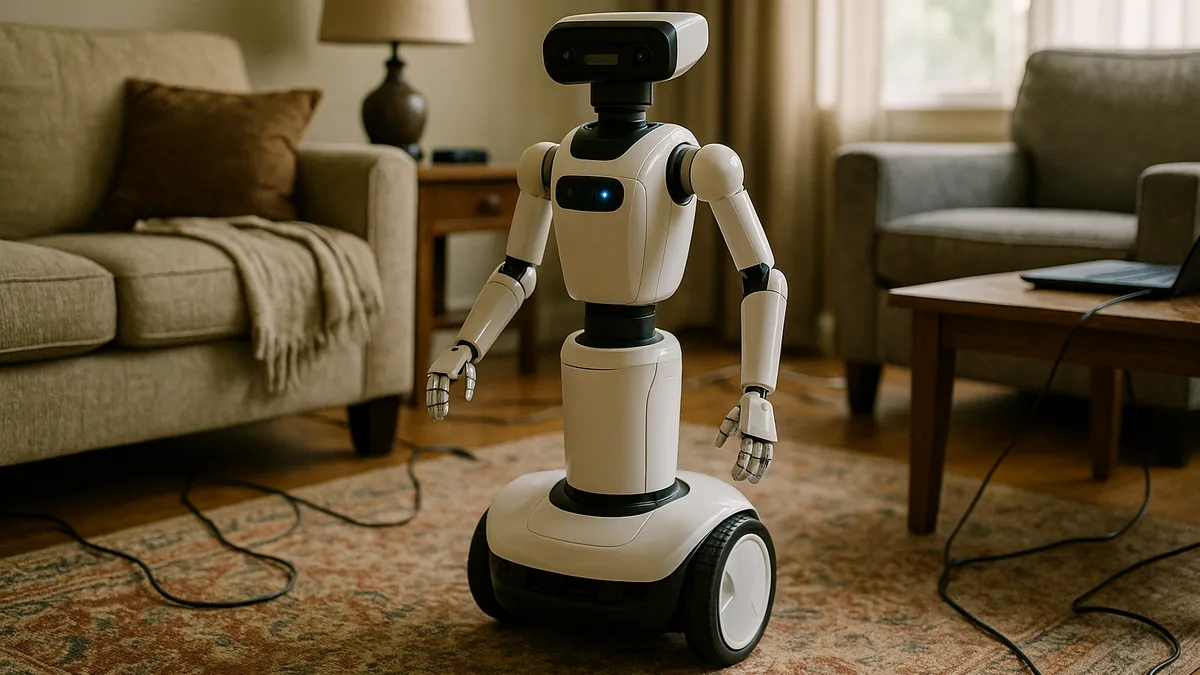
Hello Robot’s Stretch 4 is not just a faster version of its earlier home robot. The redesign is notable because it treats assistive deployment as a sensing, safety, and portability problem first, especially for people with severe mobility impairments who need a machine that can work close to the body in cluttered indoor spaces.
Built for close human collaboration, not showroom specs
Hello Robot introduced Stretch 4 at a listed price of $29,950 as an open-source mobile manipulation platform for developers, researchers, and application engineers. That framing matters: the company is still selling a platform to build on, not a finished mass-market care robot, even though the intended use case is much more practical than a lab-only prototype.
The company’s design emphasis also corrects an easy misreading. Stretch 4 is not mainly about making a home robot bigger or quicker; it is a careful effort to balance reach, mobility, and manipulation with the constraints of operating around people who may have severe mobility limitations and little margin for unsafe behavior.
The redesign starts with perception and floor-level risk
The biggest hardware story is the sensor stack. Stretch 4 uses two hemispherical 3D LiDARs, three high-resolution cameras, and six laser line sensors around the base to watch for hazards such as cords, rugs, thresholds, and drop-offs that are common in real homes but easy to understate in robotics demos.
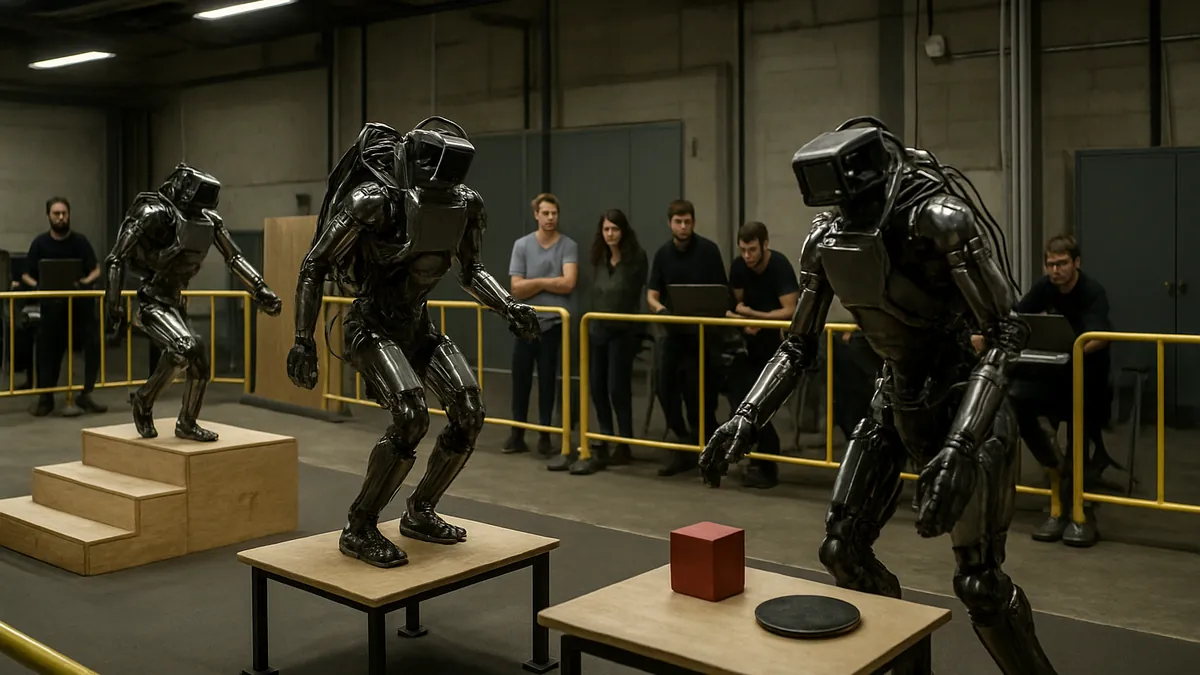
Hello Robot says the sensor head is rigidly fixed relative to the arm and base, which reduces blind spots and makes autonomous operation easier even when the arm is extended. That choice is less flashy than adding more joints, but it directly addresses a practical deployment problem: assistive robots fail in homes not only because they cannot manipulate objects, but because their world model becomes unreliable as the machine changes posture.
More speed and reach only matter because the robot stays portable
Stretch 4’s arm, lift, and base now move at twice the speed of Stretch 3, and total reach is up by 10%. It also offers eight redundant degrees of freedom plus the gripper, including an ambidextrous wrist with an integrated depth camera that can be configured for left- or right-handed use.
The mobility package is equally specific to indoor use. An omnidirectional base with 20 cm wheels is meant to travel smoothly over carpets, rugs, and thresholds, while a quick-release mechanism lets operators swap among a compliant gripper, a parallel jaw gripper, and a tablet interface depending on the task.
Power and transport are where the redesign becomes easier to judge as a deployable system rather than a bench-top upgrade. The new battery system supports up to eight hours of runtime, includes a removable pack that cuts about 30 pounds for transport, and works with an autonomous docking station for self-charging. Those details matter because a useful assistive robot cannot depend on constant manual setup; it has to last through a meaningful part of the day and still be movable by caregivers or users who are not running a robotics lab.
Safety claims are still design-led, not certification-led
Hello Robot CEO Aaron Edsinger argues that Stretch 4’s compact form and low-potential-energy design make it inherently safer than larger humanoid robots, especially if control systems fail. The company also points to choices such as avoiding actuators that fight gravity, which can reduce fall risk and improve reliability.
That is an important distinction for buyers and developers: Stretch 4 appears engineered around safer interaction, but Hello Robot is not claiming formal safety certification at this stage. For deployment beyond early adopters and research groups, the next checkpoint is not whether the robot can already demonstrate useful tasks, but whether the company can pair those capabilities with clearer certification status, lower cost, and support structures that fit broader home and enterprise use.
| Deployment checkpoint | What Stretch 4 now provides | What still limits wider rollout |
|---|---|---|
| Indoor awareness | LiDAR, cameras, and laser line sensors aimed at clutter, floor hazards, and reduced blind spots | Performance in diverse homes still depends on integration and application-specific software |
| Daily usability | Up to eight hours runtime, removable battery, autonomous docking, easier transport | Still a developer platform rather than a turnkey consumer device |
| Human-safe operation | Low-energy design, compact form, safety-focused mechanical choices | No formal safety certification claim yet |
| Broader access | Open-source platform and real assistive use cases | $29,950 price remains a major barrier for many individuals |
Where the platform already matters, and where it still does not scale
The strongest evidence for Stretch 4’s direction comes from actual users rather than abstract benchmarks. Hello Robot has pointed to early use by people with disabilities, including Henry Evans, a non-verbal quadriplegic who described the robot as an extension of his body, and another user with multiple sclerosis who used the system remotely to visit an aquarium and interact with divers through the tablet interface.
Those examples show the platform’s practical range: not only object interaction, but also remote presence and social access. At the same time, they underline the current market reality. Stretch 4 may also be tested for enterprise settings such as data center tasks, but for assistive use in homes, wider adoption will depend less on another jump in robot speed than on whether Hello Robot’s next iterations can bring down cost, secure formal safety validation, and convert a capable platform into a supportable product for people outside research institutions and early-adopter communities.