







Iran’s nationwide internet blackout in January 2026 did not prove that satellite internet cleanly escapes state control. It showed something more important for deployment reality: satellite links and satellite TV data broadcasts can break Tehran’s centralized choke points, but they also trigger a different layer of jamming, confiscation, and legal repression.
What the January shutdown actually tested
The 2026 shutdown was broader than Iran’s earlier internet cuts. Global internet access was cut nationwide, phone service was also disrupted, and mobile networks were selectively knocked offline in ways that made ordinary workarounds far less reliable.
That scale matters because Iran’s censorship system is built around concentration. Most international traffic passes through a small number of state-controlled gateways, while the National Information Network can keep domestic services running during a blackout even as access to the global web disappears. Satellite systems challenged that design because they do not depend on those gateways.
Starlink worked, then the state adapted
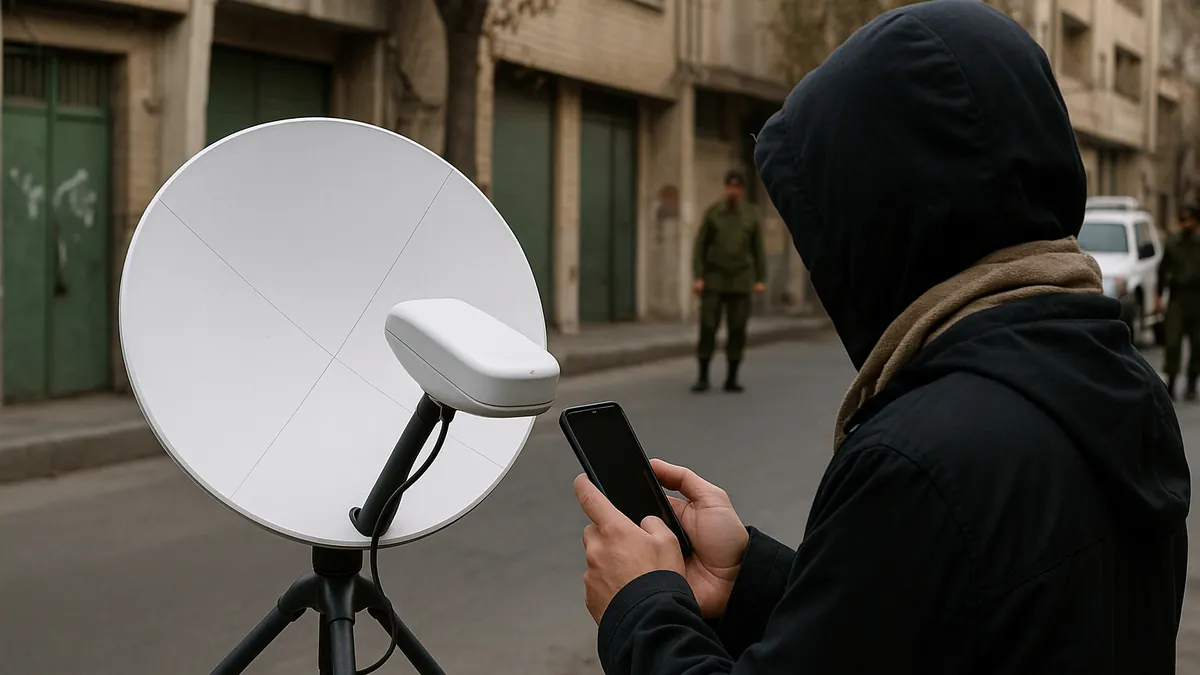
Before and during the blackout, Starlink gave many Iranians an uncensored path out of the country’s fixed internet controls. Reports put the installed base above 30,000 terminals, with use spreading despite the government’s ban on unauthorized satellite internet equipment.

But the common claim that Starlink simply bypassed censorship does not hold once the countermeasures started. Iranian authorities reportedly deployed mobile electronic warfare units, compared to Russia’s Krasukha-4 and including Iran’s own Cobra V8, to interfere with low Earth orbit satellite links; in some areas, users saw packet loss reach roughly 80%, turning nominal connectivity into unstable and often unusable service.
By mid-January 2026, those tactics had reportedly knocked many Starlink links offline in parts of the country. The practical lesson is not that satellite internet failed, but that its bottleneck in an authoritarian environment shifts from backbone control to radio-layer disruption and possession risk.
Why Toosheh is a different kind of escape route
Starlink is not the only satellite path that mattered. NetFreedom Pioneers’ Toosheh uses free-to-air satellite TV signals to send curated data bundles such as news files, tutorials, and software updates without requiring two-way communication from the user.
That design changes the enforcement problem. Because Toosheh is a one-way broadcast system rather than interactive internet access, it is harder for authorities to identify individual requests or block traffic the same way they would block a normal connection. It also leans on a familiar piece of hardware: satellite dishes that remain widespread in Iranian homes even though the state has long tried to ban and seize them.
The trade-off is capability. Toosheh can deliver information at scale with low detectability, but it is not a substitute for live communication, publishing, or direct access to outside services. In a blackout, that makes it useful for resilient distribution of selected content, not for replacing the open internet.
Different satellite paths, different failure points
The two systems matter for different reasons, and they fail under different pressures.
| System | What it provides | Why it resists central blocking | Main weakness in Iran |
|---|---|---|---|
| Starlink | Two-way internet access | Does not depend on Iran’s terrestrial gateways | Signal jamming, terminal seizure, legal penalties |
| Toosheh | One-way data bundles over satellite TV signals | No user request path for authorities to monitor in the same way | Limited to prepackaged content, still exposed through dish confiscation |
The real checkpoint is enforcement endurance
Tehran’s response has not been only technical. Security forces reportedly carried out raids, confiscated terminals and dishes, and used legal threats against users, while Iran also pushed the International Telecommunication Union to treat unauthorized satellite internet in Iranian airspace as illegal. That combination matters because it raises the cost of use even where signals remain partially available.
The next question is not whether satellite systems can bypass a centralized shutdown once. It is whether Iran can sustain jamming and seizure campaigns strongly enough to stop underground adoption, or whether activists, smugglers, and diaspora networks keep enough equipment in circulation for satellite access to remain a recurring breach in state control.
For anyone evaluating satellite connectivity under censorship, Iran’s 2026 blackout sets a clearer rule: resilience depends on more than orbital coverage. It depends on whether users can keep hardware hidden, whether links can survive localized electronic warfare, and whether one-way broadcast channels like satellite TV data can carry essential information when interactive internet becomes too risky.