







Google DeepMind’s Gemini Robotics-ER 1.6 should not be read as a routine vision upgrade. The material change is that it combines sharper spatial reasoning, multi-camera task verification, and industrial instrument reading in one embodied AI system, which is much closer to what real robot deployments need than simple object detection gains.
Where ER 1.6 moves beyond object spotting
A central improvement in ER 1.6 is how it uses pointing as an intermediate reasoning step rather than as a cosmetic interface feature. That lets the model identify specific objects, count them, and apply relational logic such as selecting only items that will fit inside a container, which matters because physical work usually fails on these small constraint errors rather than on broad scene recognition.
That change also addresses a practical robotics problem: hallucinated references are more dangerous in embodied systems than in chat interfaces. If a robot points to the wrong tool, miscounts parts, or misunderstands which object is behind another, the result is not just a wrong answer but a bad action near people, equipment, or fragile inventory.
Task completion now depends on more than one camera angle
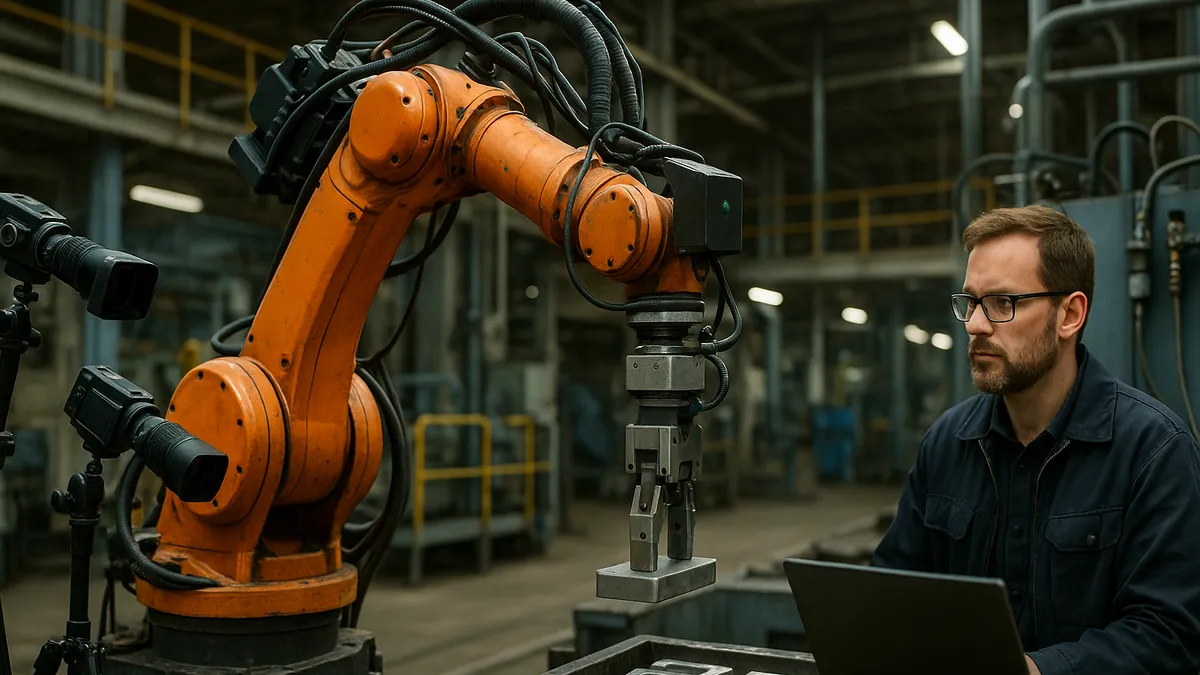
ER 1.6 also improves success detection, meaning the robot’s ability to determine whether it has actually finished a task. Instead of relying on a single viewpoint, it can combine feeds such as an overhead camera and a wrist-mounted camera to confirm outcomes even when lighting is poor or key parts of the scene are occluded.
That is a more important deployment detail than it may sound. In industrial workflows, false positives and false negatives both cost time: a robot that wrongly thinks a task is complete moves on too early, while one that keeps retrying a finished task slows the line and increases wear. Multi-view reasoning is aimed at that exact failure mode.
Instrument reading is the clearest jump toward industrial use
The most concrete new capability is instrument reading. Developed with Boston Dynamics for inspection use cases involving robots such as Spot, ER 1.6 can interpret analog gauges, sight glasses, and digital displays instead of treating these as generic visual patterns.
Google DeepMind’s reported benchmark numbers show why this stands out: instrument-reading accuracy rises from 23% in ER 1.5 to 86% in ER 1.6, and to 93% when agentic vision is enabled. Agentic vision here means the system can actively zoom, point, and use code execution to resolve hard cases such as lens distortion, crowded interfaces, or multiple needles on a gauge.
That is a different class of upgrade from “better perception.” Many industrial sites already have useful information on old panels and non-networked equipment. If a robot can read those instruments reliably enough, operators do not need to retrofit every facility before automation becomes useful.
| Capability | What changed in ER 1.6 | Practical effect |
|---|---|---|
| Spatial reasoning through pointing | More precise object identification, counting, and relational selection | Reduces misidentification and hallucination risk in physical tasks |
| Success detection | Combines multiple camera views under occlusion or poor lighting | Cuts unnecessary retries and premature task completion errors |
| Instrument reading | Supports analog gauges, sight glasses, and digital displays; 23% to 86%, or 93% with agentic vision | Makes inspection and monitoring useful on legacy industrial equipment |
| Safety behavior | 6–10% better performance on ASIMOV-related hazard recognition and physical constraint adherence | Improves refusal of unsafe plans and compliance with task limits |
Safer behavior is improving, but it is still a checkpoint, not a guarantee
DeepMind says ER 1.6 performs better on the ASIMOV benchmark, with 6–10% gains in hazard recognition and physical constraint adherence. The model is also described as better at respecting limits such as not attempting to move objects that are too heavy for a gripper and refusing harmful plans in semantically unsafe situations.
For governance and deployment teams, that matters in a narrow but important way: better benchmarked safety behavior can lower obvious failure rates, but it does not remove the need for layered controls. Real sites still need task boundaries, human override, and testing against facility-specific edge cases because embodied failures come from environment variation as much as from model intent.
Access is easier; proof at scale still is not there
ER 1.6 is available through the Gemini API and Google AI Studio, with developer tooling including a Colab notebook for embodied reasoning tasks. That opens the model to more robotics teams and supports integration across different hardware types, from robot arms to mobile systems, instead of limiting use to a single tightly controlled platform.
DeepMind is also encouraging partner feedback to tune the model on specialized datasets, which is a realistic admission that deployment quality will depend on local conditions. Factories, energy sites, and mining environments differ too much for one benchmark result to settle readiness across all of them.
The next serious checkpoint is not another demo. It is whether instrument reading and multi-view success detection hold up in large-scale industrial deployments where lighting changes, sensors drift, interfaces age, and workflows are less clean than controlled evaluations.
Quick questions teams will ask first
Is this mainly for humanoid robots? No. The positioning here is broader, with support for integration across diverse robotic hardware, including mobile platforms and robot arms.
What is the strongest signal of practical progress? The jump in instrument reading accuracy, especially with agentic vision, because it targets real inspection work on existing industrial equipment.
What should buyers or operators validate early? Multi-view success detection and instrument reading under their own lighting, occlusion, and camera placement conditions, not just benchmark conditions.
Does better safety benchmarking mean deployment-ready autonomy? Not by itself. It improves the case for supervised and bounded autonomy, but site controls and failure testing still decide whether the system is fit for use.