







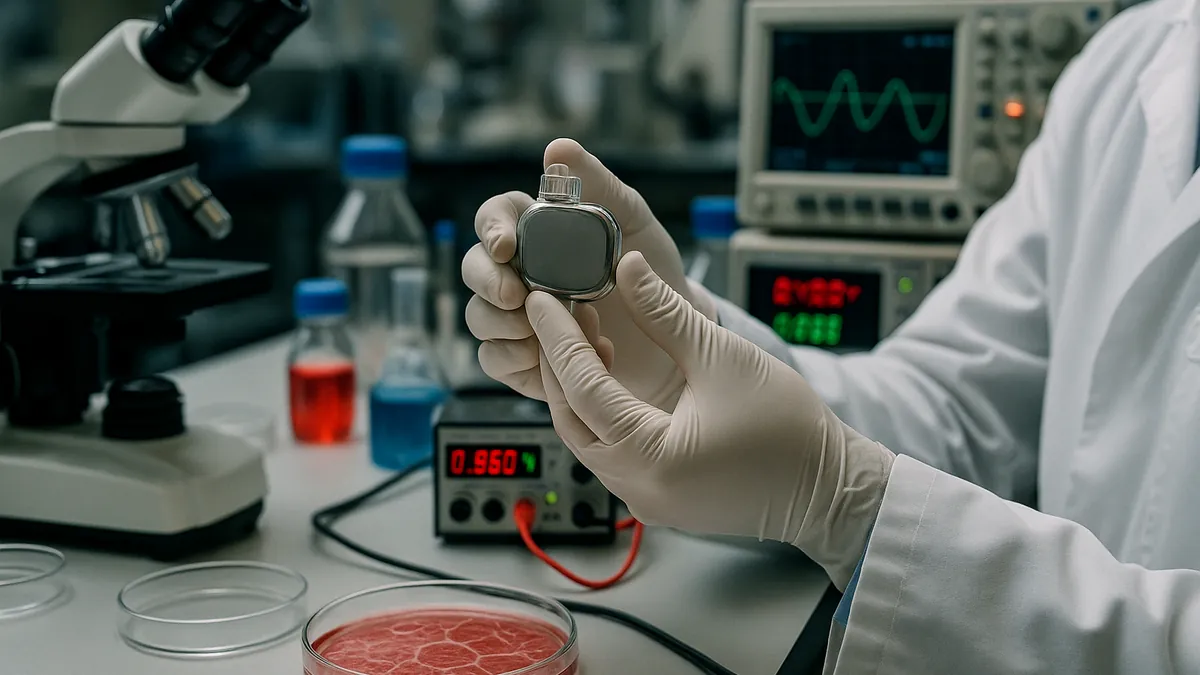
HOBIT is not just a small implant that stores medicine. It is a cell-based drug factory, and the part that changed its performance was an internal oxygen generator. In early rodent studies, the device kept engineered cells alive long enough to produce three biologics at once—an anti-HIV antibody, a GLP-1-like peptide for diabetes, and leptin—by splitting water molecules inside the implant to supply oxygen where subcutaneous tissue usually cannot.
Why oxygen changed the result
Implanted therapeutic cells often fail for a simple reason: they are packed densely into a small space, then placed into tissue with limited oxygen diffusion. That hypoxic environment quickly reduces cell survival and makes drug output unstable. HOBIT, developed by teams at Northwestern, Rice, and Carnegie Mellon, addresses that bottleneck directly with electrochemical water splitting inside the device rather than relying only on oxygen reaching the implant from surrounding tissue.
That mechanism translated into a measurable difference in the reported rodent data. Oxygenated implants maintained about 65% cell survival after 31 days, compared with roughly 20% for implants without oxygenation. The researchers also reported stable blood levels of all three therapeutics across that period, which matters because simultaneous delivery is harder when each biologic has different production and clearance dynamics.
What is inside the device
HOBIT is roughly the size of a folded stick of gum and combines three parts in one implant: a chamber holding genetically engineered mammalian cells, a localized oxygen generator, and wireless electronics for control and communication. The compact format matters because oxygen support, cell viability, and external control are usually treated as separate engineering problems; here they are integrated into one implantable system.
The practical distinction is that the implant can support higher cell density instead of thinning out the biological payload to match passive oxygen availability. The draft reports around six times higher cell densities than unoxygenated versions. That is the enabling condition for turning an implant from a short-lived release site into a sustained producer of multiple biologic drugs.
How HOBIT differs from other living-drug platforms
Other groups are also pursuing implantable “living pharmacy” systems, including work from MIT and Harvard on genetically modified bacteria inside hydrogels. Those approaches can be programmable and can produce multiple compounds on demand, but they run into related oxygen diffusion problems in dense materials. They also bring an extra materials problem when oxygen is supplied through peroxide-based chemistries: maintaining usable oxygen gradients without harmful byproducts.
HOBIT’s current result points to a narrower but important lesson for deployment reality: for implantable cell factories, oxygen handling is not a secondary optimization. It is core infrastructure. Without a stable local oxygen source, adding more engineered cells or more complex gene circuits does not reliably increase therapeutic output, because viability collapses first.
| System | Drug source | Oxygen strategy | Main limit | Status marker |
|---|---|---|---|---|
| HOBIT | Engineered mammalian cells | Electrochemical water splitting inside implant | Need to prove long-term safety and stability beyond rodents | 31-day rodent data with about 65% cell survival |
| Unoxygenated cell implants | Engineered cells | Passive diffusion from tissue | Hypoxia, low survival, inconsistent release | About 20% survival after 31 days in controls |
| Bacterial hydrogel implants | Genetically modified bacteria | Often limited by diffusion; some use oxygen-generating materials | Oxygen gradients and toxic byproducts can undermine long-term stability | Parallel research stage |
The next bottleneck is no longer just biology
The next verified checkpoint is larger-animal testing that can show three things at once: long-term safety, durable oxygen generation, and sustained therapeutic output under conditions closer to human implantation. Rodent success does not answer how the oxygen system behaves over longer periods, whether local chemistry creates tissue damage, or how stable the electronics remain when the implant is expected to operate continuously.
Regulation will also be more complicated than for a passive implant because HOBIT combines biologic production, implantable hardware, and wireless control. In the US, the Food and Drug Administration would likely review it through pathways involving biologics and combination products, with close attention to chronic implantation risks, device reliability, and consistency of drug expression over time. If the platform expands toward pancreatic cell applications or other chronic-use settings, post-implant monitoring and data handling become part of the product, not an add-on.
Who should read this result cautiously
For clinicians and investors, the useful reading is not “three drugs from one implant” in isolation. The more important threshold is whether the oxygen subsystem can remain safe and predictable enough to support high-density living cells over clinically meaningful durations. If that does not hold in larger animals, the multi-drug concept remains technically interesting but operationally weak.
For developers building programmable living implants, including wireless or externally tuned systems, another constraint appears later in the stack: control security. The draft notes risks such as malicious reprogramming, which means future versions may need encrypted communications and biological containment measures such as kill switches. In other words, once oxygen sustains the cells, governance shifts toward keeping the device controllable, auditable, and safe for long-term use.