









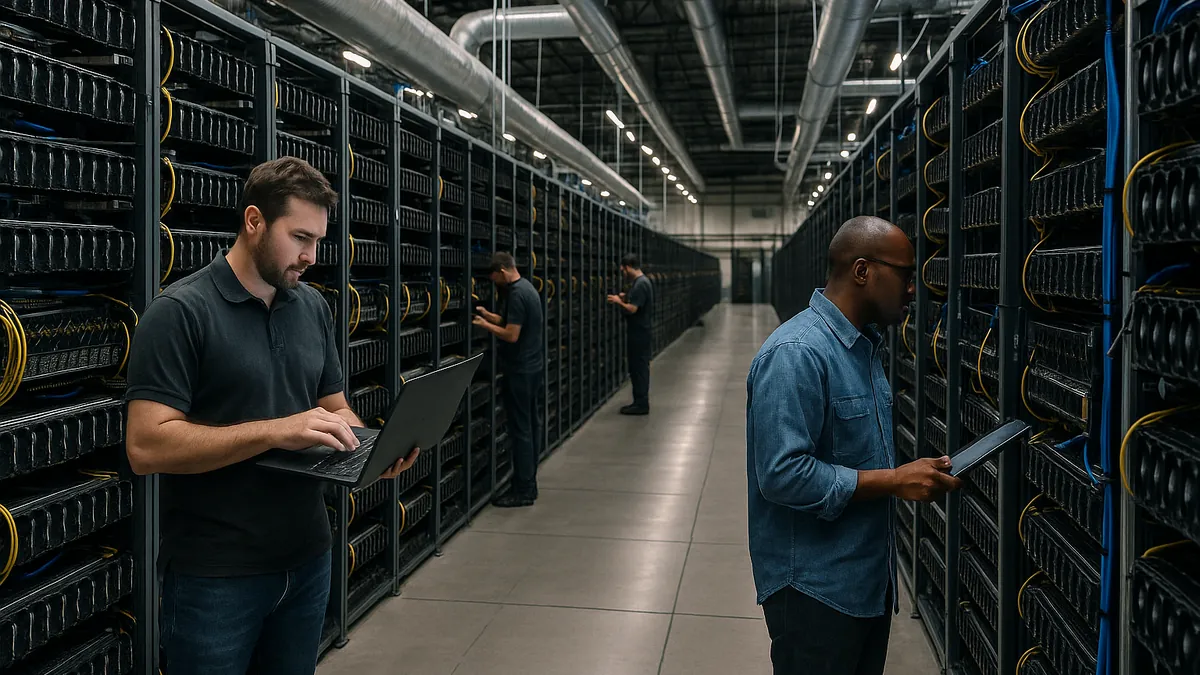
Decentralized AI training is not a simple replacement for giant GPU clusters. Its real advantage is narrower: spreading workloads across locations can reduce cooling demand and make cleaner electricity easier to use, but once training depends on tight coordination across many sites, bandwidth, latency, and fiber costs start eating away at those gains.
The energy case is real, especially when location changes the power mix
Frontier model training now runs on infrastructure so large that site design matters as much as chips. Systems on the scale used for models such as GPT-4 or Gemini 1.0 Ultra rely on tens of thousands of GPUs or TPUs, can draw well over 150 megawatts, and require multi-billion-dollar buildouts. In that environment, distributing compute across multiple facilities can lower one of the biggest operating burdens: heat concentrated in a single place.
Cooling can account for as much as 40% of datacenter operating expense, so moving compute into several regions can reduce both thermal density and the amount of specialized cooling equipment needed at any one site. Geographic spread also creates a carbon advantage that centralized clusters do not always have. If training runs where the grid is cleaner, emissions can fall sharply; the draft’s example compares Northern Sweden with Germany, showing that the same training job can carry a much lower footprint simply because the electricity mix is different.
Why distributed training slows down long before compute runs out

Large centralized clusters work because their networking is built for synchronization. Inside those facilities, technologies such as NVIDIA NVLink and InfiniBand move gradients quickly enough that thousands of accelerators can train together with high utilization. Even then, operators often break giant deployments into smaller “islands” to manage power delivery and cooling, and performance already drops when communication shifts onto slower, higher-latency links such as Ethernet.
That problem gets worse when the cluster is no longer one cluster. Training across dozens of datacenters means repeatedly exchanging model updates over long-distance fiber rather than over tightly engineered in-rack and in-campus fabric. For modern large-scale training, gradient synchronization can require petabit-scale data movement and sub-millisecond latency if efficiency is to stay close to centralized baselines. Public internet paths add packet loss, routing variability, and extra hops; even private fiber adds propagation delay and coordination overhead that cannot be wished away. Research into gradient compression and asynchronous training exists precisely because the network becomes the limiting resource once compute is geographically separated.
Where the cost trade-off turns against decentralization
The common misread is that spare compute scattered across the world can simply be aggregated into a cheaper training cloud. In practice, the further a system moves toward tightly coupled distributed training, the more it starts paying infrastructure costs that resemble a new kind of hyperscale buildout. The savings on cooling and site flexibility do not arrive for free.
| Potential benefit | What creates friction | Practical effect |
|---|---|---|
| Lower cooling load by spreading heat | More sites to connect, monitor, and coordinate | Operational complexity rises with each added datacenter |
| Ability to train on cleaner regional grids | Distance increases latency during synchronization | Carbon improves, but training efficiency can drop |
| Use of underutilized compute across sites | Need for high-bandwidth links and error handling | Idle compute is not automatically usable for frontier training |
| Avoidance of one massive single-site build | Fiber installation can cost roughly $0.50 to $16+ per foot | Network capex can consume much of the expected savings |
That cost range matters because decentralized training only works at scale if links between sites are engineered, not improvised. Laying and maintaining fiber across many locations becomes a capital decision, not just a networking decision. Once operators also account for synchronization overhead, retransmission, and software complexity, a geographically distributed design can end up cheaper on power but worse on time-to-train or total delivered cost for the largest models.
Places where decentralized AI already makes sense
The strongest current use cases are not frontier foundation-model training. They are workloads where local action matters more than constant global synchronization. In smart grid management, decentralized models can improve energy efficiency by making decisions closer to the source, reducing round trips to central servers, and responding better to local conditions. Federated learning and peer-to-peer energy trading fit this pattern because coordination costs are lower than in tightly coupled large-model training, while resilience and energy savings are easier to realize.
That distinction matters for deployment decisions. “Decentralized AI” is not one thing: an edge-heavy control system and a globally synchronized pretraining run place completely different demands on the network. The former can benefit from distributed placement today; the latter still runs into hard physical limits.
The next checkpoint is algorithmic, not just electrical
Hardware efficiency will keep improving on both sides. Mixed-precision methods such as FP8 reduce computational demand, and newer accelerators may lower power per operation. But those gains do not remove the central trade-off between compute density and communication delay. They improve the baseline; they do not erase the cost of moving synchronized state over distance.
The next variable worth watching is whether advanced gradient compression and asynchronous training methods can materially reduce network pressure without damaging model quality or extending training too much. If those techniques become good enough, decentralized training could move from niche deployments toward larger-scale use. Until then, the likely near-term outcome is split: centralized clusters remain the default for frontier research, while decentralized systems win in cases where energy location, resilience, or local decision-making matters more than perfect synchronization.