







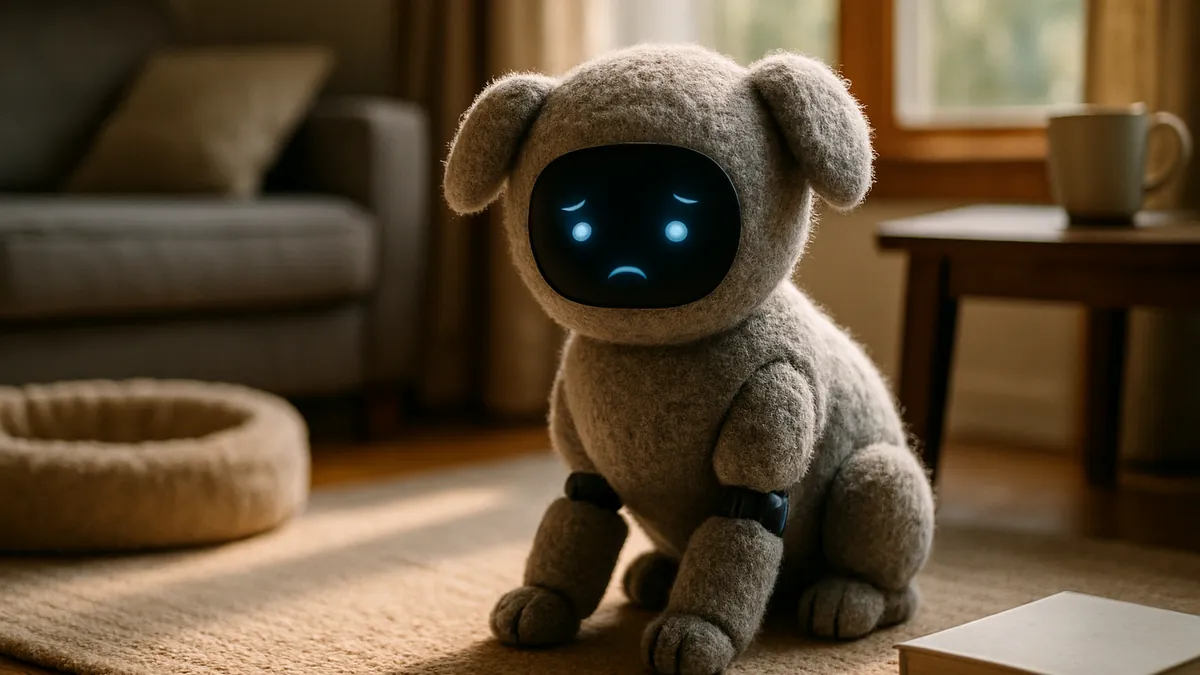
Colin Angle’s new startup, Familiar Machines & Magic, is not building a better Roomba-style helper for the home. Its robot, the Familiar, is a small quadruped meant to be lived with rather than used for chores, using on-device AI and pet-like behavior to address loneliness, routines, and everyday emotional support.
A companion machine, not a household assistant
The easiest way to misread Familiar is as an early general-purpose home robot. It is explicitly narrower than that: roughly the size of a small dog, covered in a touch-sensitive fuzzy exterior, and built with 23 degrees of freedom so it can communicate through posture, movement, facial expressions, purring, and meowing rather than speech.
That design choice is also a capability limit. Familiar cannot grasp objects or climb stairs, which rules out the practical jobs people often imagine when they hear “home robot.” It is not meant to carry groceries, fetch medication, fold laundry, or act as a mobile smart speaker. The product thesis is that emotional presence itself is the function.
Why the AI runs on the robot
Familiar’s AI stack runs locally on Nvidia Jetson Orin hardware instead of relying on constant cloud streaming. According to the company’s pitch, the robot combines vision, audio, language, and memory on-device so it can interpret cues such as tone of voice, facial expression, and household context in real time.
That matters for more than privacy marketing. A companion robot that is always waiting on remote inference can feel delayed, brittle, or intrusive in a home setting, especially if it is supposed to “read a room” and react through movement. Edge inference does not remove all safety or governance questions, but it does change the deployment reality: lower dependence on connectivity, less need to stream intimate household behavior off the device, and tighter coupling between sensing and response.
The trade-off is that on-device social reasoning has to work within real hardware constraints. Running multimodal generative models locally can improve responsiveness and data control, but it also narrows what the system can do compared with a cloud-heavy architecture. In Familiar’s case, that seems intentional: the product is choosing a bounded social role over a broad but less dependable assistant model.
What the robot is supposed to do in daily life
Angle says the Familiar is meant to learn household routines and adapt over time. The practical value, if it works, is not task execution but behavioral nudging: encouraging healthier habits, breaking up doomscrolling, and providing a steady social presence for people who want interaction at home without the demands of a live animal.
That puts the robot in a different category from voice assistants and screen-based AI. Familiar Machines & Magic is betting that embodied, nonverbal interaction can feel more natural and less mentally taxing than speaking commands to a device. The company also avoids making the robot closely resemble any one animal, apparently to keep users from projecting expectations the machine cannot meet.
There are specific users who may find that framing more relevant than a utility robot. People who cannot keep pets, live alone, or want lightweight emotional support may see value in a machine that responds physically and remembers routines. But the same design sharply limits the addressable market among buyers who still expect a home robot to do visible work.
Where the claim is strongest, and where it is still unproven
Familiar Machines & Magic has credible robotics lineage behind it. Colin Angle founded iRobot, and the team reportedly includes people from iRobot, Disney Imagineering, MIT, and Boston Dynamics. The startup is targeting a tentative 2027 release and says pricing should be comparable to pet ownership, though it has not published exact numbers.
The strongest supported claim is that this is a deliberate shift away from chore-first domestic robotics toward emotionally aware, physically embodied AI. The weaker claim is commercial durability. Companion robots have a long history of attracting initial interest and then struggling once novelty fades, and Familiar’s success will likely depend less on demos than on retention: whether users keep engaging after weeks and months, whether the robot’s learned behavior actually becomes useful, and whether people accept a machine that offers comfort and routine support without ever becoming a functional helper.
The real checkpoint is not launch but sustained attachment
If Familiar reaches market, the important signal will not be whether people find it charming on first contact. It will be whether emotional connection can hold up as a product category in the home, especially when the device cannot climb stairs, manipulate objects, or replace human or animal companionship.
That makes adoption patterns the key checkpoint. A companion robot can look technically impressive and still fail if users stop interacting with it after the novelty window closes. For investors, operators, and anyone tracking AI deployment in the home, Familiar is best read as a test of a narrower proposition: can on-device, embodied AI create enough ongoing value through presence and behavior alone to justify a place in daily life?