





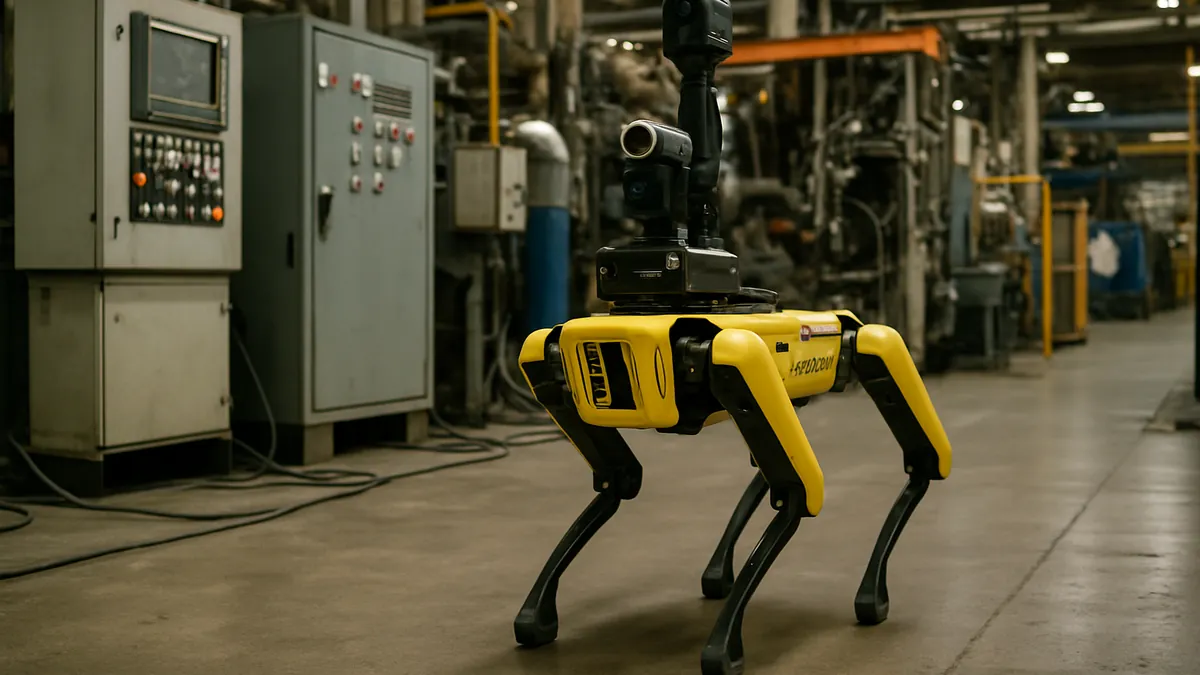
Boston Dynamics has integrated Google DeepMind’s Gemini Robotics-ER 1.6 into Spot, turning the quadruped from a scripted inspection robot into one that can reason through industrial tasks such as reading gauges, checking instruments, and carrying out multi-step actions from natural language prompts. The important shift is not just easier control: Gemini is handling embodied decision-making inside Spot’s API boundaries, while still operating with clear safety and sensing limits.
From scripted routes to embodied task sequencing
Boston Dynamics said in April 2026 that the new integration builds on earlier Gemini Robotics work and its own Orbit AIVI-Learning platform. In practice, this changes how Spot is deployed in industrial settings. Instead of relying mainly on hand-built state machines or explicit task programming, developers can issue instructions in ordinary language and let the model sequence the needed actions across navigation, object identification, manipulation, and task completion checks.
The distinction matters because Spot is not simply receiving a voice interface. A prompt such as “make sure all shoes at the front door are on the shoe rack” requires the system to break the request into subproblems, identify relevant objects, choose an order of operations, and call the robot’s controls through the SDK. That is a materially different capability from a robot that follows a prewritten route and logs images for later review. For industrial users, the value is lower workflow engineering overhead in environments where conditions change too often for rigid scripts to hold up.
Why gauge reading is the first concrete deployment story
A major part of Gemini Robotics-ER 1.6 is improved instrument reading. Boston Dynamics and Google DeepMind focused on analog gauges, thermometers, and digital readouts that operators routinely inspect in factories, utilities, and energy sites. These are small but consequential tasks: a robot that can interpret a dial correctly and flag an abnormal reading can reduce the number of manual rounds in hazardous or hard-to-reach areas.
The update also improves spatial reasoning and “success detection.” Gemini synthesizes multiple camera views to judge whether an action actually worked, which is one of the persistent weak points in robotics. A grasp, placement, or inspection pass is only useful if the system can verify the result under occlusion, odd angles, or poor lighting. According to the draft source, early benchmarks showed about a 30 percent task-accuracy improvement over previous Gemini Robotics versions. That makes the current rollout notable less for general robotics ambition than for a specific industrial inspection threshold: Spot can now interpret visual state and physical task outcome more reliably enough to take on inspection work that previously stayed human-supervised.
What the system can do now, and where it still breaks
The current package is strongest when the environment can be understood visually and the task can be executed within known robot constraints. It is weaker when safe manipulation depends on touch, force, slippage, or other physical signals that cameras alone do not capture well. DeepMind’s own framing points to that gap: grasp success detection is improved through multi-view vision, but full understanding of physical interaction remains incomplete because the training base for multimodal robotic data is still limited.
That limit is easy to miss if Gemini Robotics is described only as natural-language control. The harder problem is not interpreting the sentence; it is deciding whether the robot has actually grasped the right object, whether a dial is damaged or partially obscured, or whether a container should be handled differently because the contents may spill. Vision-only reasoning can support useful inspection and some manipulation, but it does not yet provide the same confidence as combined visual, tactile, and force feedback in messy real-world environments.
| Area | Current strength in Spot + Gemini Robotics-ER 1.6 | Current constraint | Practical effect |
|---|---|---|---|
| Natural language control | Can translate prompts into multi-step robotic actions through Spot’s SDK | Still bounded by available APIs and approved robot actions | Less custom coding for inspections and repetitive workflows |
| Gauge and instrument reading | Improved reading of analog and digital indicators | May struggle with damaged instruments, occlusion, or difficult lighting | Better fit for routine industrial inspection rounds |
| Success detection | Uses multi-view camera synthesis to verify task completion | Relies primarily on vision rather than tactile or force sensing | More reliable than single-view checks, but not full physical certainty |
| Manipulation safety | Can refuse overweight or hazardous-object requests and respect physical limits | Full semantic safety for manipulation is still under development | Useful guardrails, but not a reason to remove operational oversight |
Safety controls are real, but not complete
The rollout is aimed at hazardous industrial inspection partly because even partial autonomy can reduce human exposure to risky spaces. Gemini Robotics-ER 1.6 is designed to follow physical constraints and decline some unsafe actions, including picking up overweight items or handling hazardous materials such as liquids. That gives operators a more concrete safety envelope than a generic “AI-powered” label suggests.
But the source material also makes clear that semantic safety for manipulation is not fully deployed in the current Spot implementation. That is an important governance point for anyone evaluating autonomy in critical infrastructure. A model that can refuse obviously disallowed actions is not the same thing as a robot that robustly understands all contextual hazards in a plant, substation, or refinery. Boston Dynamics’ cautious beta approach reflects that gap: these systems are being advanced in commercial settings, but not as fully self-governing field workers.
The next checkpoint is multimodal sensing, not better prompting
Spot already gives Google DeepMind something many embodied AI groups lack: a real installed base. Boston Dynamics has several thousand Spot units in industrial environments, which creates a practical testbed for seeing where reasoning models hold up and where they fail under dirt, glare, clutter, wear, and inconsistent equipment conditions. That deployment reality is more valuable than demo fluency because it exposes the exact conditions that block scale.
The next verified checkpoint is whether future Gemini Robotics versions move beyond vision-heavy reasoning and incorporate richer multimodal input such as tactile feedback. That is the clearest path to better grasp confirmation, safer handling, and fewer failure cases when the physical world does not look cleanly readable from cameras alone. For industrial buyers, the decision lens is straightforward: treat the current Spot-Gemini stack as an increasingly capable inspection and constrained manipulation system, not as a solved general robotics platform.