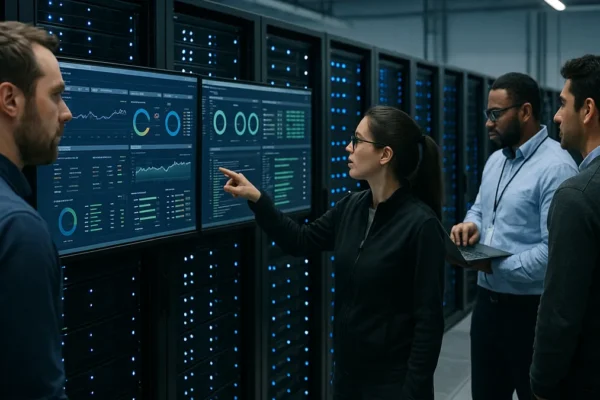










Engineers working inside a data center surrounded by server racks and monitoring performance on screens.

AlphaEvolve’s strongest signal is verified optimization, not generic AI coding

Google DeepMind’s AlphaEvolve matters because it is already producing verified gains inside real systems, not because it can generate code on command. The useful distinction is that AlphaEvolve is a Gemini-powered evolutionary loop that proposes, tests, scores, and revises algorithms against explicit performance targets and hardware constraints. Why “AI coding agent” is the wrong mental…

Read More
A busy call center with diverse agents wearing headsets working at computers with CRM software visible on screens.

Parloa vs. Generic Voice Bots: Where Enterprise Customer Service AI Actually Gets Hard

Parloa is not best understood as a chatbot vendor or a smarter call router. Its actual proposition is an enterprise AI agent management platform for voice-heavy customer service, built for organizations that need live conversational handling, system integration, and compliance controls to work together from day one. Voice automation that goes beyond scripted call flows…

Read More
Engineers and scientists collaborating in a modern AI research lab with computers and code on screens.

Anthropic’s 2028 AI Training Forecast Puts Governance, Not Just Capability, at the Center

Anthropic’s estimate that there is better than a 60% chance AI systems will autonomously train their successors by 2028 matters because it shifts recursive self-improvement from a speculative idea into a near-term planning problem for labs, companies, and governments. The important correction is that this is not yet a picture of runaway autonomy; today’s systems…

Read More
Bankers working at computers in a modern office with financial data and AI tools visible on screens.

Why Singular Bank’s AI rollout matters for private banking operations, not just chatbot demos

Singular Bank’s Singularity assistant is notable because it turns generative AI into an operational system inside a regulated private bank, not a generic front-end chatbot. By combining ChatGPT with Codex and connecting both to the bank’s internal platforms, the Madrid-based firm says it cuts routine prep and reporting work enough to return 60 to 90…

Read More
A teenage person sitting alone on a park bench looking at their smartphone in daylight

Mental Health Chatbots Now Face a Safety Test They Often Fail

Mental health and youth-facing chatbots are no longer plausibly treated as neutral software tools. Recent research and new legislation point in the same direction: these systems often fail basic safety and privacy checks in predictable ways, and regulators are starting to require guardrails that many deployments still do not meet. Research is finding repeatable failure…

Read More
A group of professionals collaborating in a modern office with computers and AI-related displays visible on screens.

GPT-5.5 Instant Is Not a Cosmetic ChatGPT Refresh but a Default Model Swap With Fewer Hallucinations and New Memory Controls

OpenAI has replaced ChatGPT’s default model with GPT-5.5 Instant, and the important change is not cleaner tone or fewer emojis. Starting May 5, 2026, the default experience for ChatGPT users shifted to a faster model that OpenAI says materially reduces hallucinations in medicine, law, and finance while adding a new way to see and manage…

Read More
A patient wearing a brain-computer interface device with visible electrodes and embedded hardware, assisted by medical staff in a clinical lab setting.

Why This Brain-Controlled Exoskeleton Matters for Rehabilitation Infrastructure, Not Consumer Wearables

A new brain-computer interface result stands out for one specific reason: it did not just decode walking intent, it paired real-time exoskeleton control with bilateral sensory feedback on a portable embedded system. That makes it more relevant to rehabilitation engineering for paraplegic spinal cord injury patients than to the common narrative that exoskeleton BCIs are…

Read More
Finance team collaborating around a conference table with laptops and documents in a modern office setting.

Why OpenAI’s Finance Team Matters to CFOs: PwC Is Turning AI Agents Into a Governed Operating Model

OpenAI and PwC are not treating finance AI as a lab exercise or a simple automation project. They are using OpenAI’s own finance organization as “customer zero” to test whether AI agents can handle procurement, contract review, forecasting, reporting, and investor relations work inside real controls, real systems, and real accountability structures that a CFO…

Read More
A doctor consulting with a patient using AI-assisted technology displayed on a computer screen in a clinical setting.

Google DeepMind’s AI Co-Clinician Is Strongest as a Supervised Teammate, Not an Autonomous Doctor

Google DeepMind’s AI Co-Clinician matters because it pushes medical AI beyond a chatbot or back-office assistant, but its real advance is narrower than some headlines suggest: it works best as a supervised clinical teammate inside the consultation, not as a doctor substitute. The system combines multimodal inputs and multi-agent checks to support decisions in real…

Read More
A software developer coding on a laptop with multiple screens showing code and network diagrams in an office setting.

OpenAI’s WebRTC Voice Push Cuts Browser Latency, but Production Still Runs Through Your Backend

OpenAI’s Realtime API now makes sub-second browser voice interactions more practical by using WebRTC instead of WebSockets, but that does not turn voice AI into a plug-and-play feature. The performance gain is real; the missing piece in many first readings is that security, session control, backend actions, and deployment reliability still sit with the developer….

Read More