








The useful distinction is not cloud versus edge, or chips versus networking. The material change is that faster AI inference hardware and AI/ML-native Wi-Fi are starting to solve the same deployment problem together: how to run real-time models efficiently while moving less data, wasting less spectrum, and staying inside tight power budgets.
Two upgrade paths are converging
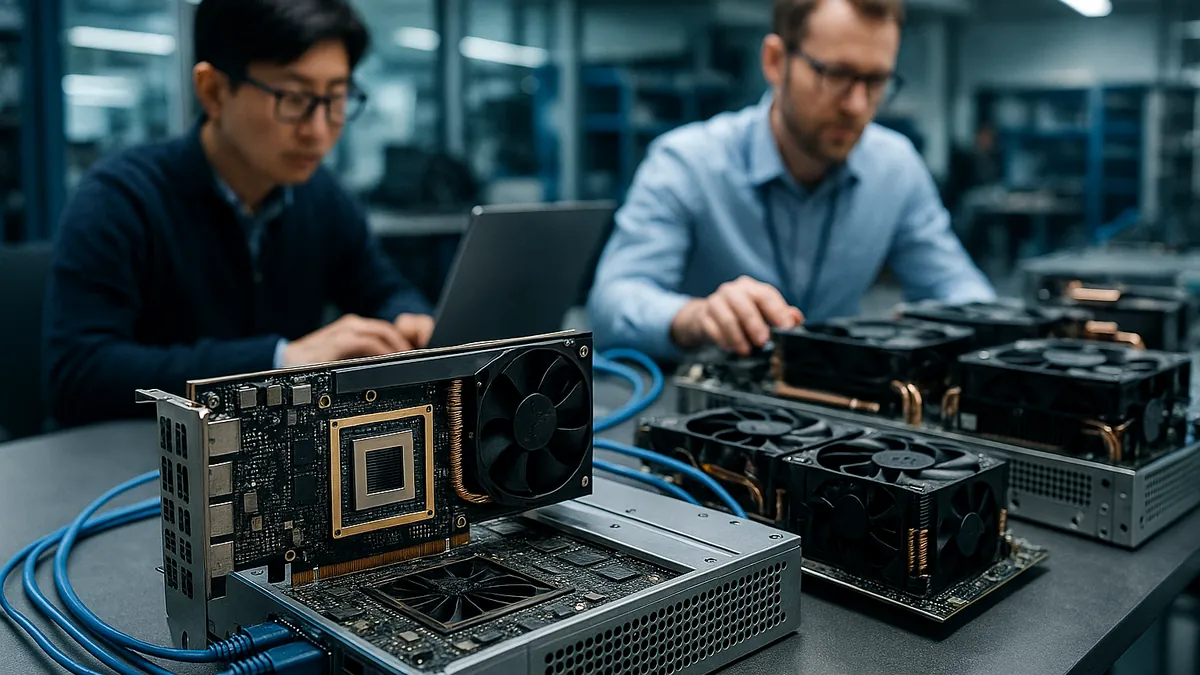
On the compute side, vendors are pushing inference performance higher with specialized designs for different operating environments. NVIDIA’s Jetson T4000 and T5000 modules, built for robotics and industrial edge systems, deliver more than 1,200 and 2,000 FP4 sparse teraflops respectively, while Google’s TPU v6 and v7 focus on data-center economics with optical circuit switching and optimizations for agentic AI workflows.
Those are not isolated product stories. Edge systems need local response under strict latency and power constraints, while cloud systems need lower inference cost at scale; both cases benefit when the network layer also becomes more efficient and more adaptive instead of simply carrying growing AI traffic the old way.
What changes when Wi-Fi starts adding AI inside the protocol
AI in Wi-Fi today is mostly used around the network rather than inside it. Operators already use AI/ML for analytics, fault isolation, and automated troubleshooting through proprietary management platforms, but that does not yet mean the wireless protocol itself is AI-native.

The IEEE 802.11 AIML Topic Interest Group is working on exactly that next step. One concrete area is channel state information feedback compression, where neural networks can reduce the amount of CSI data stations need to send back for beamforming, cutting overhead that becomes increasingly costly as systems move toward coordinated transmissions and up to 16 spatial streams in Wi-Fi 8.
That distinction matters because protocol-level AI changes deployment math. If beamforming feedback can be compressed effectively, dense enterprise, industrial, and multi-AP environments may gain throughput and reliability without paying the same control-plane penalty, but the endpoints now need enough local compute to run those compression models efficiently.
Why the hardware roadmap and the Wi-Fi roadmap depend on each other
Inference chips are being designed around efficiency techniques such as low-precision arithmetic, compiler-level layer fusion, dynamic voltage and frequency adjustment, and memory layouts that reduce data movement. At the manufacturing level, extreme ultraviolet lithography and stacked high-bandwidth memory are what make it possible to sustain trillions of operations per second without blowing past thermal limits.
Those same efficiency pressures show up in wireless design, just in a different form. A robot, camera, gateway, or industrial controller that runs more inference locally can cut round trips to the cloud, but if it also participates in AI-assisted Wi-Fi tasks such as CSI compression or smarter link adaptation, then chip capability, memory bandwidth, radio scheduling, and battery or thermal limits become one shared systems problem rather than separate procurement decisions.
That is the common misread to avoid. AI inference accelerators and AI/ML in Wi-Fi are often discussed as separate trends, yet in practice they are becoming interdependent layers of the same deployment stack: the chip determines what can be computed in time, and the network determines whether those decisions can be coordinated efficiently across devices, access points, and cloud services.
Where the trade-offs differ by deployment type
| Deployment setting | Primary chip priority | Primary Wi-Fi or network priority | Main constraint |
|---|---|---|---|
| Industrial edge and robotics | Low-latency local inference under tight power and thermal limits | Reliable coordination in dense or mobility-heavy environments | On-device compute added for AI-assisted radio functions can compete with application workloads |
| Enterprise Wi-Fi networks | Efficient inference for analytics, vision, and local automation | Reduced control overhead and better beamforming across many clients and APs | Standard support may lag proprietary operator tools |
| Cloud and hyperscale data centers | Inference cost reduction, throughput, and workflow optimization | Fast interconnect and traffic steering rather than client Wi-Fi behavior | Infrastructure gains do not automatically translate to better edge responsiveness |
The practical difference is that not every buyer should evaluate these changes the same way. A data-center operator looking at Google TPU generations will care about inference cost per workload and network fabric efficiency, while an industrial integrator evaluating Jetson-class modules has to ask whether the device can run both the application model and emerging wireless intelligence functions without creating a new power or thermal bottleneck.
The next checkpoints are standardization and power-performance discipline
The next technical checkpoint is not a single product launch. It is whether upcoming IEEE 802.11 releases move AI/ML-native mechanisms from exploratory work into formalized features, and whether endpoint silicon keeps improving the power-performance trade-off enough to support those features outside premium hardware tiers.
A simple decision lens follows from that. If a deployment depends on immediate gains, today’s operator-centric AI tools for Wi-Fi management are the available path; if it depends on protocol-level gains such as standardized CSI compression and more native AI behavior in the radio stack, timing and interoperability risk remain real and should be planned as such.
For teams building edge AI systems now, the constraint to watch is not raw teraops alone. It is whether the combined budget for inference, memory movement, radio processing, and thermal control still holds once AI starts shaping both the application workload and the wireless link that carries it.