








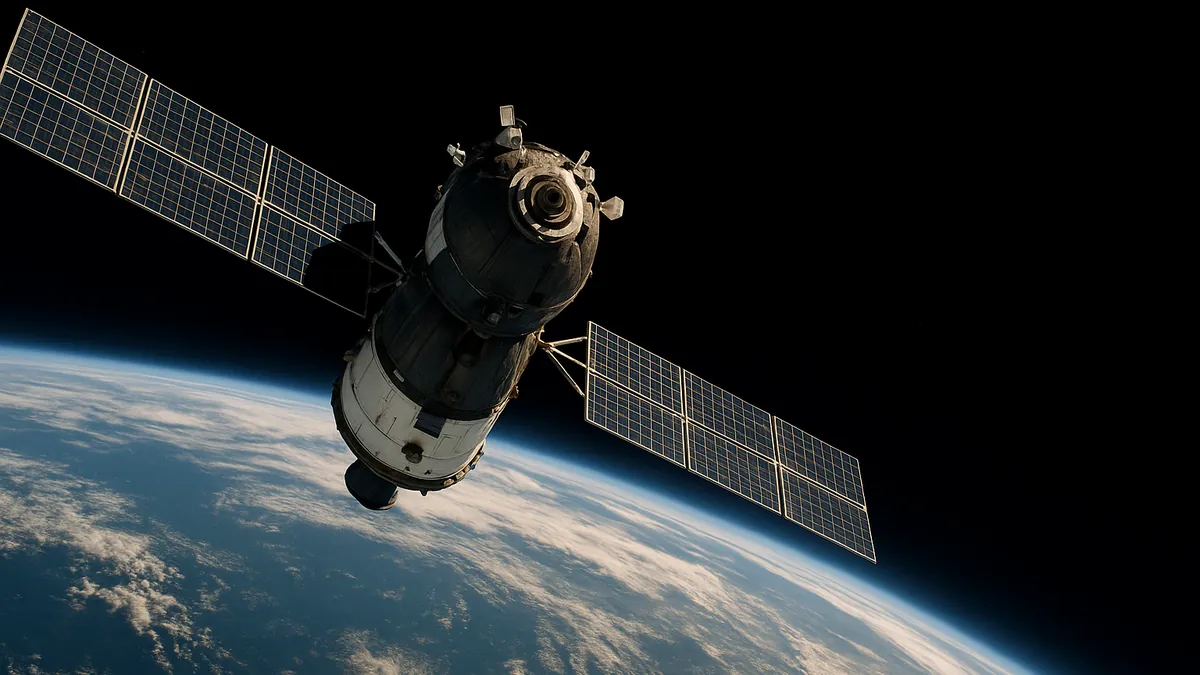
Orbital’s 2027 satellite mission makes orbital AI infrastructure more concrete than it was a year ago, but the immediate story is still validation, not displacement. The strongest signal is that companies are narrowing the target to AI inference in low-Earth orbit because energy, cooling, and sovereignty pressures are real on Earth, while the technical and economic limits in space are still severe.
Orbital is testing a specific slice of AI compute
U.S. startup Orbital plans to launch Orbital-1 in April 2027 on a SpaceX Falcon 9, using the mission to test sustained GPU operations and radiation hardening for AI inference workloads. That matters because it turns a vague idea of “AI data centers in space” into a measurable checkpoint with named hardware, a launch window, and a concrete operational goal.
The company is not starting with model training. Orbital is targeting inference because those jobs are more distributed and stateless, can often tolerate more latency than training clusters, and may degrade more gracefully when radiation causes occasional bit errors in memory or processing.
Its pitch is tied to infrastructure constraints on Earth rather than pure novelty. In sun-synchronous low-Earth orbit, satellites can draw near-continuous solar power and rely on radiative cooling, which in principle eases two major terrestrial bottlenecks: access to enough electricity and the difficulty of removing heat from dense compute systems.
Why space looks attractive only for narrow workloads
Orbital’s case depends on the idea that some AI jobs do not need the same environment as giant terrestrial training clusters. If inference can be broken into smaller, resilient tasks, then an orbital system does not have to match an on-premise or hyperscale cloud data center on every metric to be useful.

That still does not make space-based compute a near-term, cost-effective replacement for terrestrial data centers. Launch costs, shielding, satellite design, networking, and hardware replacement all add friction, and those burdens are much harder to hide in compute economics than a simple “free solar power in space” story suggests.
Orbital’s own operating model reflects that constraint. Rather than assuming in-orbit servicing will be routine, it is building around a replace-not-repair lifecycle and a dedicated Los Angeles manufacturing site, Factory-1, for specialized compute satellites. CEO Euwyn Poon has framed the advantage less as immediate price leadership than as a way to scale outside terrestrial grid delays, land constraints, and permitting friction that increasingly slow new data center deployments.
Peers are pushing different use cases, not one shared model
Pixxel and Orbit AI show that “orbital AI” is already splitting into different product and governance paths. Pixxel’s Pathfinder mission, scheduled for Q4 2026, is being built to run datacenter-class GPUs and full-stack AI models in orbit, with an emphasis on hyperspectral data analysis and reducing the need to send raw sensor data back to Earth before processing.
That makes Pixxel’s approach more tightly linked to space-native data itself. Working with India’s Sarvam, the company is also framing orbital compute as sovereign AI infrastructure, meaning the appeal is not just power and cooling but control over where sensitive processing happens and which cloud providers or jurisdictions are avoided.
Orbit AI is taking a broader aggregation route, combining satellite compute and sensing into AI-native products while emphasizing censorship resistance and blockchain-linked services. Its framing is less about replacing cloud infrastructure wholesale and more about creating politically and architecturally distinct compute layers that are harder for terrestrial authorities or platforms to interrupt.
The bottlenecks that will decide whether this scales
The hardest part is not proving that a GPU can operate in space for a short period. The harder question is whether a fleet can deliver stable, high-availability AI inference with acceptable failure rates, replacement cycles, networking performance, and unit economics once radiation, thermal swings, and hardware degradation are treated as normal operating conditions rather than edge cases.
Industry caution is already visible. IDC analyst Ashish Nadkarni has pointed out that data centers are not just racks of chips; they are managed systems that require upgrades, intervention, and ongoing optimization, all of which are harder to reproduce in orbit. Inter-satellite networking and standards are also still developing, which limits how quickly orbital systems can behave like flexible distributed compute fabric instead of isolated experimental nodes.
| Checkpoint | Why it matters | What would count as a warning sign |
|---|---|---|
| Radiation resilience | Inference may tolerate some errors, but repeated bit flips can still break reliability and economics | Frequent memory corruption, heavy shielding needs, or steep performance overhead from mitigation |
| Power management | Solar energy is only useful if the system can continuously deliver stable power to GPUs and support loads | Large power variability, curtailed workloads, or battery demands that erase the supposed advantage |
| Thermal control | Radiative cooling is promising, but dense compute still has to reject heat predictably in operation | Thermal throttling, reduced GPU utilization, or hardware life shortened by heat stress |
| Network architecture | Useful orbital inference depends on moving tasks, outputs, and sensor data efficiently | Weak inter-satellite links, high coordination overhead, or poor integration with terrestrial systems |
| Replacement economics | A replace-not-repair model only works if launch cadence and satellite cost stay within a viable range | Short satellite life, expensive refresh cycles, or utilization too low to justify replenishment |
Watch the missions, not the ambition statements
The next real evidence will come from Orbital-1 in 2027 and Pixxel’s Pathfinder in late 2026. Those missions should provide data on radiation tolerance, sustained inference performance, and whether orbital power and cooling translate into usable compute rather than a technically impressive but commercially narrow demonstration.
SpaceX adds a separate signal about where this could go if the early engineering works. Its FCC filings describe plans for a constellation of up to one million solar-powered AI satellites, which is far beyond the scale of current startup efforts and suggests that major players see orbital compute as more than a publicity concept. But that filing is not proof that the deployment model is ready now; it is proof that the industry is seriously exploring a new infrastructure layer.
For operators, regulators, and national technology planners, the decision lens is straightforward. Orbital AI matters first where terrestrial build-outs are blocked by grid access, cooling constraints, data sovereignty requirements, or censorship risk, and where inference workloads can tolerate the physical realities of space. If Orbital and Pixxel cannot show durable GPU operation and manageable failure economics on those narrow terms, the case for scaling orbital data centers weakens quickly.