





The 2015 DARPA Robotics Challenge was valuable because it tested whether disaster-response robots could keep working through real operating constraints, not because it proved humanoid robots were ready for field deployment. By forcing teams to complete eight sequential mobility and manipulation tasks under degraded communications and without physical resets, the challenge exposed where supervised autonomy worked, where it failed, and why robot design choices mattered under pressure.
Eight tasks, one hard standard
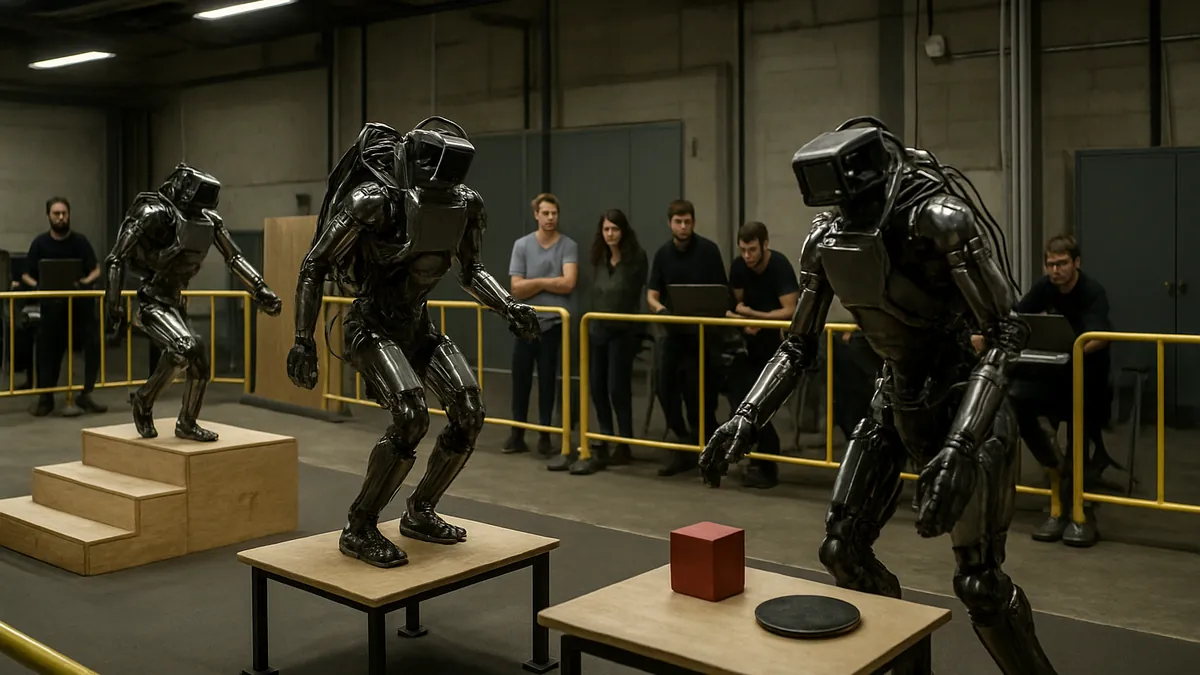
DARPA did not set up the DRC as a collection of isolated demos. Robots had to drive a utility vehicle, traverse terrain, open doors, turn valves, cut through a wall, and use tools as part of a continuous sequence. That matters because success in disaster response depends less on a single impressive motion than on whether a machine can move from one problem to the next without being manually recovered after every mistake.
The communications rule made the test more realistic. Teams had to operate with intermittent, low-bandwidth links that reflected the kind of degraded network conditions likely at a nuclear site, industrial accident zone, or other hazardous area. In that setting, a robot that depends on constant operator correction is not just inefficient; it may become unusable at the moment conditions get worst.
Different robot bodies revealed different operating bets
The finalists did not converge on one obvious humanoid blueprint. Carnegie Mellon’s CHIMP kept a near-human structure aimed at strength and dexterity, while NASA-JPL’s RoboSimian used a four-limbed design built around stability and multi-point contact. Those are not aesthetic differences. They represent different answers to a deployment question: should a robot prioritize human-like reach and tool use, or physical steadiness in cluttered, unstable environments?
That comparison is easier to see when the design trade-offs are placed side by side:
| Platform | Design emphasis | Operational advantage | Practical cost or limit |
|---|---|---|---|
| CMU CHIMP | Strength and dexterity in a near-human form | Better fit for human-built tools and spaces | Higher balance and control complexity |
| NASA-JPL RoboSimian | Four-limbed stability and anchoring | More stable movement on irregular structures | Less direct alignment with human-like task execution |
| WPI-CMU Atlas (WARNER) | Reliable supervised autonomy with careful task execution | Completed nearly all tasks without falls or resets | Still constrained by communication loss and recovery limits |
WPI-CMU showed what reliability actually looked like
The WPI-CMU team’s Atlas robot, WARNER, stood out not because it looked the most human, but because it stayed operational. It completed seven of eight tasks without falling or needing a reset, an unusually strong result in a field where a single loss of balance could end a run. In deployment terms, that kind of consistency matters more than peak capability because disaster sites punish fragile systems.
The team also pointed to a more specific control gap: many robots did not use environmental supports the way humans do. Railings, walls, and other contact points can reduce balance risk, but robotic control systems often treated the environment as something to avoid rather than something to lean on strategically. That is a software and planning problem as much as a hardware one, and it explains why apparent strength or dexterity on paper did not always produce stable task completion in practice.
Communication loss changed the autonomy requirement
One of the clearest lessons from the finals was that degraded connectivity was not a side condition; it was the operating condition. During the event, the WPI-CMU team experienced a six-minute communication loss during a critical phase. That kind of interruption makes teleoperation-centered control brittle, because the operator cannot continuously patch over weak perception, balance instability, or planning errors.
This is where the DRC should be read carefully. The challenge advanced supervised autonomy, meaning robots could execute parts of a task sequence with human oversight, not full independence. The practical next checkpoint is whether future humanoid systems can detect errors, shift into fallback behaviors, and recover enough function during outages to avoid becoming dead weight in the field. Adaptive control and autonomous error recovery are more important indicators of deployment progress than whether a robot can complete a scripted benchmark under ideal connectivity.
Who should read the DRC as a warning, not a launch signal
For emergency-response agencies, robotics programs, and companies building humanoid platforms, the DRC is best used as a filter for procurement and design claims. A robot that performs a single manipulation task in a lab says little about whether it can survive a long sequence, avoid falls, recover from mistakes, and keep operating when bandwidth collapses. Those are different engineering thresholds, and the DRC made them visible.
The event also narrowed the most important questions for anyone evaluating the next generation of humanoid robots. Ask whether the platform can recover from falls, whether the operator interface reduces human error instead of creating it, and whether autonomy degrades gracefully when communications drop. If those answers are weak, then the system is still closer to a research platform than a disaster-response machine, regardless of how human-like it appears.