






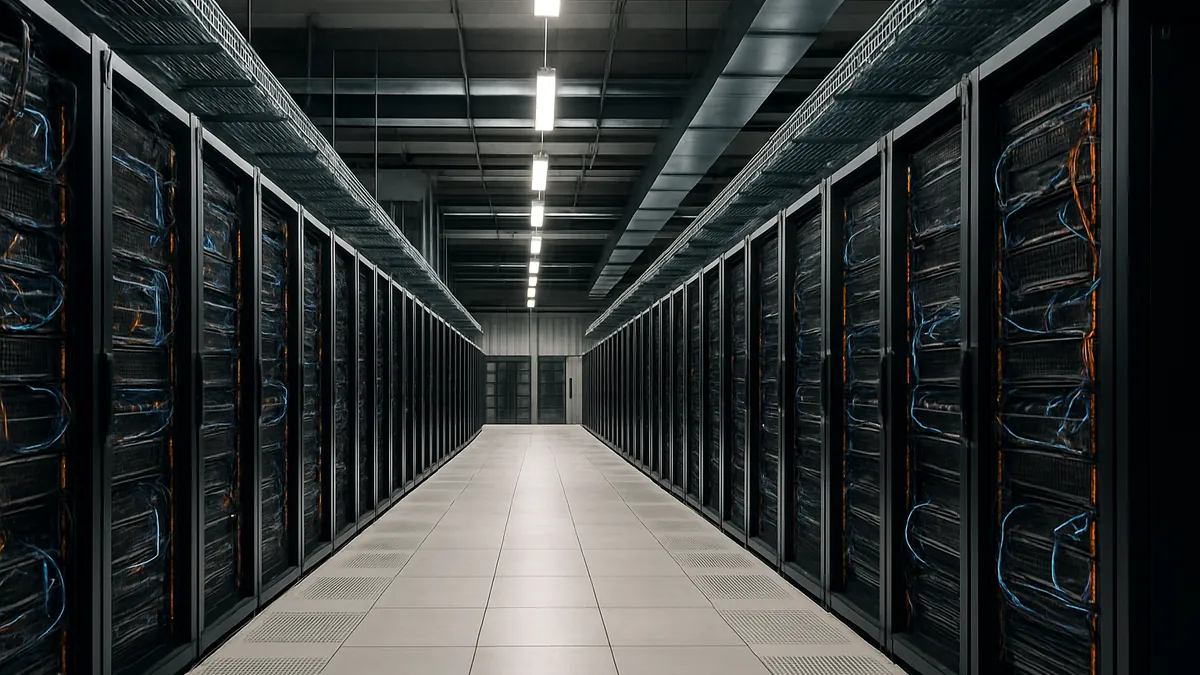
AI data centers are not moving toward 800 VDC simply to swap one power standard for another. The important change is architectural: operators are pairing high-voltage DC distribution with integrated energy storage to cut conversion loss, handle fast GPU-driven load swings, and make very high rack densities easier to build than with legacy AC chains.
Where the AC model starts to break under AI load
Traditional data centers have long accepted repeated AC-to-DC and DC-to-AC conversions as normal. That model becomes expensive at AI scale. In a conventional server path, each conversion stage sheds power as heat, and server power supplies commonly operate around 90% to 95% efficiency. In dense AI racks, that leftover 5% to 10% is no longer a rounding error; it becomes a cooling and operating-cost problem measured in kilowatts.
High-voltage DC changes the path rather than just tuning the parts. By centralizing conversion at the facility level and distributing native DC power to racks, operators can remove multiple conversion stages. The result, according to the source draft, is a facility energy-efficiency improvement of roughly 7% to 20%. That matters more as rack power densities move from the old tens-of-kilowatts range toward 1 MW and beyond, where every avoided watt of loss also reduces thermal management burden.
800 VDC is not Edison’s old DC story

A common misreading is to treat this as a simple return to direct current after a century of alternating current dominance. That misses the actual enabler: modern solid-state power electronics. Today’s 800 VDC designs depend on fast protection, digital monitoring, current limiting, and high-ratio DC-DC conversion close to the load. This is a different system from historical DC distribution, both in control and in safety behavior.
NVIDIA’s MGX and Kyber rack architectures are concrete examples of that newer model. Their approach uses an 800 VDC backbone with DC-DC converters that step power down efficiently to the voltages GPUs need. ABB is pushing the supporting layer from the infrastructure side, including LVDC components, MVAC-to-LVDC conversion equipment, and solid-state breakers meant for safe 800 VDC deployment. Standards work from groups such as ODCA and Current/OS also matters here because adoption depends on repeatable implementation rules, not just isolated engineering demos.
Why integrated storage matters as much as the voltage shift
The most important difference between AI facilities and older enterprise data centers is not only higher average demand. It is volatile, synchronous demand. Large GPU clusters can ramp together and create abrupt swings in power draw, which can stress utility interconnects and force operators to oversize feeders, backup systems, and internal distribution just to survive short spikes.
This is where 800 VDC plus energy storage becomes more than an efficiency upgrade. Batteries and other storage systems are inherently DC assets, so they can connect more directly into a DC distribution network with fewer conversion penalties. In practice, that allows multi-timescale buffering: some storage can absorb very fast transient changes, while other capacity supports longer balancing and backup functions. The effect is to smooth the data center’s visible load profile and reduce how tightly the facility’s internal AI workload volatility is coupled to grid stability. That is a deployment reality issue, not a theoretical one, especially in markets where utilities are already struggling to provision new high-density AI loads quickly.
What changes physically inside the building
The efficiency argument is only part of the case. At higher distribution voltages, the same power can move with less current, which cuts the size and mass of conductors. Compared with 110/220 VAC systems, 400 or 800 VDC can reduce copper conductor weight and volume by roughly 3.3x to 13x. In large halls, that means less cable bulk, simpler routing, and more usable white space for compute or cooling infrastructure.
That physical simplification becomes more valuable as operators try to scale modularly rather than overbuild everything on day one. Lighter conductors, smaller bus structures, and more direct integration of DC-native assets such as batteries, solar, or fuel cells can make expansions easier to stage against actual demand. The practical gain is not elegance; it is whether the facility can keep adding AI capacity without repeatedly reworking the power room and cable plant.
| Power architecture | Main strengths | Main limits under AI load | Adoption pattern |
|---|---|---|---|
| Legacy AC end-to-end | Mature supply chain, familiar operations, broad installed base | Multiple conversion losses, heavier copper needs, less natural fit for batteries and DC-native sources | Still dominant in most existing facilities |
| Rack-level or partial HVDC | Captures some efficiency gains, lower migration risk, useful as an intermediate step | Does not remove all conversion stages or fully simplify facility power flows | Likely first phase for many operators |
| End-to-end 800 VDC with integrated storage | 7% to 20% efficiency gain potential, direct battery integration, better handling of volatile GPU demand, much lower conductor mass | Needs a mature component ecosystem, operational retraining, and broader deployment confidence | Emerging now, especially in new AI-focused builds |
The next checkpoint is ecosystem depth, not just pilot success
The near-term question is not whether 800 VDC works in principle. It is whether operators can buy, certify, maintain, and scale a full chain of components beyond early rack-level deployments. Breakers, converters, monitoring systems, battery interfaces, and operational tooling all have to mature together if data centers are going to move from partial HVDC islands to full end-to-end DC architectures.
That makes the next checkpoint straightforward. Watch whether major operators adopt 800 VDC only inside AI racks, or extend it across facility distribution and storage integration. If the industry stops at localized deployments, AC remains the dominant building architecture with some DC optimization around the edges. If the supply chain around standards-based 800 VDC keeps filling out, then the shift is larger: AI data centers start to look less like upgraded legacy halls and more like power-managed compute plants built around DC from the start.