










Cybersecurity professionals collaborating in an office, working on computers with code and security data visible on screens.

OpenAI’s GPT-5.4-Cyber Changes the Real Decision in AI Security: Verification Now Matters as Much as Capability

OpenAI’s GPT-5.4-Cyber is not a general release of a more aggressive security model. It is a controlled shift in deployment: a fine-tuned GPT-5.4 variant with lower refusal boundaries for defensive cybersecurity work, made available only to identity-verified defenders through an expanded Trusted Access for Cyber program. Who this model is actually for GPT-5.4-Cyber is built…
Read More
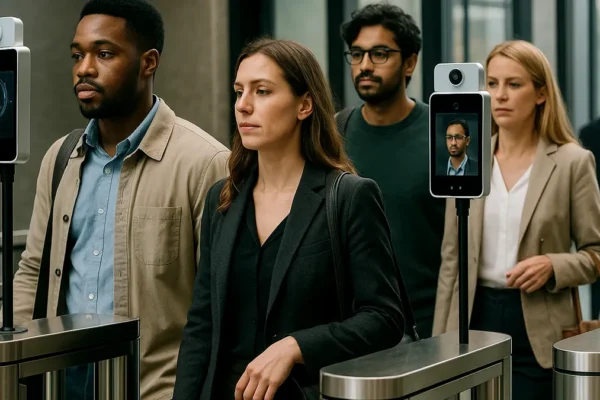
A group of people walking through an office entrance with facial recognition cameras scanning their faces for access control.

Facial Recognition Is Expanding Fast, but Deployment Still Turns on Bias, Privacy, and Local Law

Facial recognition is spreading across security gates, bank onboarding flows, retail systems, and hospitals, but the real story is not universal replacement of older identity checks. The technology works best as a conditional tool: useful for contactless verification and faster screening, yet limited by uneven accuracy, biometric privacy risk, spoofing threats, and country-by-country legal constraints….

Read More