









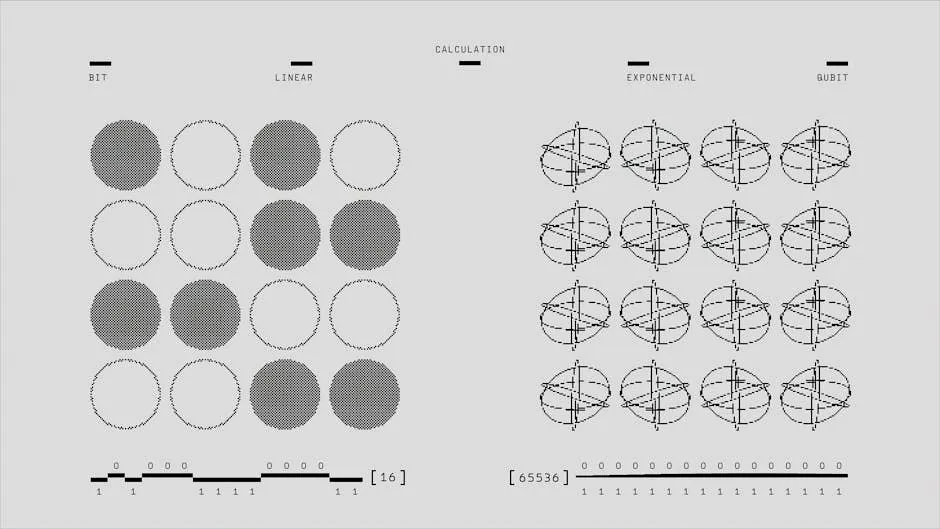
Recent breakthroughs in quantum computing are stirring a profound rethinking of machine learning through the lens of quantum machine learning (QML). This isn’t merely theoretical; it stands poised to redefine our approach to complex data challenges across sectors like healthcare, finance, and artificial intelligence. The urgency of these developments lies in their potential to revolutionize how we process and analyze vast datasets.
Understanding Quantum Machine Learning
At the heart of QML lies the concept of quantum bits, or qubits, which operate on principles that starkly contrast with classical bits. Unlike classical bits, which can only exist in a state of 0 or 1, qubits thrive in a realm of superposition, allowing them to represent multiple states simultaneously. This unique capability enables quantum computers to evaluate a vast array of potential solutions concurrently.
For example, in optimization scenarios, quantum algorithms could shift the time needed to find optimal solutions from an exponential scale to a polynomial one. This leap could disrupt industries reliant on intricate calculations, providing a significant advantage in processing speed and efficiency.
Key Principles of Quantum Computing
Entanglement, another fundamental principle in QML, further complicates the picture. Here, qubits become interlinked such that the state of one qubit can influence another, regardless of the distance separating them. This phenomenon empowers quantum algorithms to tackle tasks that classical systems struggle with, such as managing extensive datasets with unprecedented efficiency.
Techniques like Quantum Support Vector Machines and Quantum Principal Component Analysis leverage these principles to enhance conventional machine learning tasks. They improve data classification and dimensionality reduction, making it easier to extract meaningful insights from complex datasets.
Challenges in Practical Application
However, the transition to practical applications of QML is not without its challenges. A significant barrier lies in the current landscape of quantum hardware, which is dominated by noisy intermediate-scale quantum (NISQ) devices. These machines are susceptible to errors stemming from decoherence and noise, raising questions about the reliability of QML algorithms.
Consequently, achieving consistent, real-world results remains a formidable challenge. The performance of quantum algorithms can fluctuate based on the quality of the underlying hardware, creating uncertainty for researchers and practitioners alike.
Future of Quantum and Classical Machine Learning
A prevalent misconception surrounding QML is the belief that it will entirely supplant classical machine learning methods. In truth, the future likely holds a more nuanced reality: a hybrid model where both quantum and classical systems coexist. This integration allows researchers to harness the strengths of each technology, enhancing machine learning solutions for targeted tasks.
Such a framework could lead to more effective applications, particularly in fields demanding rapid data processing and analysis. As researchers explore these hybrid models, the potential for innovation expands significantly.
What are the implications of QML in various industries?
The implications of successfully weaving QML into various industries are staggering. In drug discovery, for instance, QML could dramatically expedite the analysis of complex biological data, facilitating quicker identification of potential drug candidates. In finance, quantum-enhanced algorithms could refine risk assessment models by analyzing vast datasets in real time, yielding insights previously thought unattainable.
What barriers exist for the adoption of QML?
Operational constraints add another layer of complexity to the adoption of QML. The requirement for practitioners to possess a deep understanding of both quantum mechanics and machine learning can deter those from traditional machine learning backgrounds. This necessity complicates the integration of QML into existing workflows and may slow its practical adoption.
Verification and Empirical Research
Verification boundaries are crucial for assessing the real-world applicability of QML. Factors such as the specific configurations of quantum computing platforms, the conditions under which algorithms are tested, and the datasets used for training must be meticulously controlled to ensure reliable outcomes. Without rigorous testing across diverse environments, the touted advantages of QML may not translate effectively into practical applications.
The scarcity of empirical research validating the theoretical advantages of QML fosters skepticism among researchers, who often perceive the field as more theoretical than practical at this juncture. Addressing these concerns through rigorous studies will be essential for the credibility of QML.
The Road Ahead for Quantum Machine Learning
As access to quantum computing resources becomes increasingly democratized through cloud-based platforms, the momentum of innovation in QML is likely to surge. Major companies are now offering cloud access to quantum processors, enabling researchers and developers to experiment with QML without the burden of costly hardware. This newfound accessibility could spark a wave of research and development, cultivating a collaborative atmosphere where fresh ideas can thrive.
In summary, quantum machine learning embodies a transformative convergence of quantum computing and artificial intelligence, with the potential to reshape various sectors. Continuous research and development will be pivotal in addressing these issues, paving the way for insights and applications that could redefine the landscape of data processing and analysis.