








Facial recognition is spreading across security gates, bank onboarding flows, retail systems, and hospitals, but the real story is not universal replacement of older identity checks. The technology works best as a conditional tool: useful for contactless verification and faster screening, yet limited by uneven accuracy, biometric privacy risk, spoofing threats, and country-by-country legal constraints.
Where the market is already committing budget
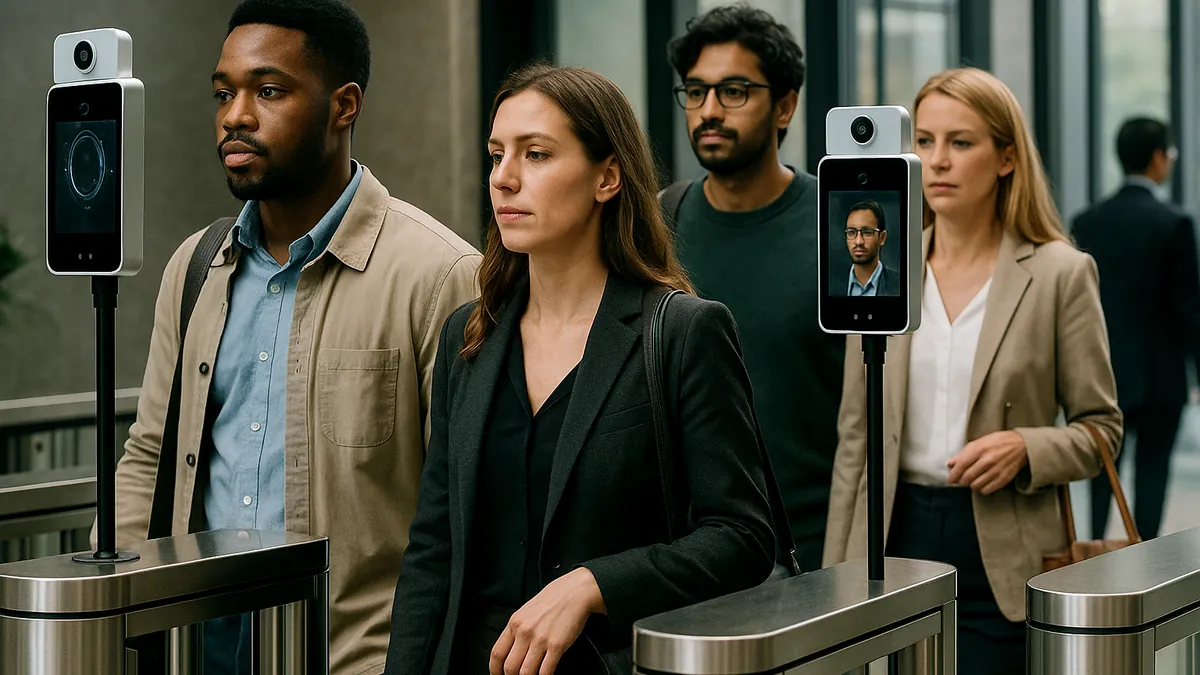
Access control and security systems accounted for more than one-third of facial recognition market revenue in 2025, a concrete sign that deployment is being driven first by controlled environments rather than by a blanket takeover of all identity workflows. That makes sense operationally: offices, campuses, hospitals, and other managed sites can define who should be recognized, where cameras are placed, and what happens after a match.
In those settings, facial recognition competes directly with badges, PINs, and manual checks. The advantage is lower friction and less impersonation through shared credentials, especially when systems can compare live video against approved or flagged lists and alert staff in real time. Companies including CyberLink, through its FaceMe platform, have pushed this model into offices, schools, and healthcare facilities because the value is clearest when entry permissions and response rules are already structured.
Finance shows the upside and the legal ceiling

Banking and fintech have adopted facial recognition most aggressively through electronic Know Your Customer, or eKYC, because it can replace branch visits with remote identity proofing. A customer can submit a live facial capture, match it to a government ID, and complete onboarding far faster than with in-person verification, which lowers acquisition cost and can reduce some forms of application fraud.
But this is also where the “facial recognition replaces everything” claim breaks down. eKYC rules differ by country, and those legal differences determine whether a face match is sufficient, whether additional records must be checked, how long biometric data can be kept, and whether certain transaction types need stronger proof. In practice, deployment in finance is shaped as much by compliance architecture as by model performance.
The main technical gain comes with extra layers, not face matching alone
Organizations using facial recognition in higher-risk contexts are increasingly pairing it with multi-factor authentication rather than treating it as a standalone credential. That means combining a facial match with a password, token, device binding, or another factor so that a single failure does not open the door to unauthorized access.
Liveness detection is part of the same shift from convenience feature to security system. By using 3D sensing or infrared checks to determine whether the subject is a live person rather than a printed image, replayed video, or mask, operators reduce spoofing risk that simple camera-based matching cannot fully address. South Korea’s identity verification approaches, which in some cases require both facial recognition and password input, reflect this layered model.
Bias and privacy are not side issues because they change where the technology is fit to use
Accuracy problems are not distributed evenly. Facial recognition systems have repeatedly shown higher error rates for women and people of color, usually because training datasets were not diverse enough or because real-world capture conditions differ from development environments. That matters far more in law enforcement, hiring, or any high-consequence decision than in a low-stakes attendance system, which is why deployment decisions should be tied to error tolerance, not just to average accuracy claims.
Privacy risk also scales with deployment style. A company using facial recognition for employee entry logs faces a different governance burden than a surveillance network scanning large populations. More than 60 countries have adopted facial recognition for surveillance uses, which sharpens the civil-liberties concern because biometric data can be persistent, hard to revoke, and revealing beyond simple identity. Encryption, strict access controls, retention limits, and clear internal rules are not optional add-ons when a system stores face templates or links them to other personal records.
| Use case | Operational benefit | Main friction or limit | What usually makes it workable |
|---|---|---|---|
| Access control in offices, schools, hospitals | Fast, contactless entry and reduced credential sharing | False matches, watchlist errors, biometric data handling | Restricted environment, clear permissions, human review for alerts |
| Financial eKYC | Remote onboarding and reduced branch dependence | Country-specific legal requirements and fraud pressure | Document checks, liveness detection, retention and consent controls |
| Retail and marketing | Personalization, repeat-customer recognition, contactless payment | Consent, customer trust, unclear value against privacy cost | Limited scope, explicit notice, narrow data use |
| Healthcare identification | Faster patient identification and safety response | Sensitive data exposure and high consequence of mistakes | Tight access control, audit logs, role-based use |
The next deployment checkpoint is governance quality, not just better models
Technical improvement will matter, especially in bias mitigation and privacy-preserving design, but rollout pace will depend on whether organizations can show that the system is bounded, reviewable, and appropriate for the specific task. A face-matching model with stronger demographic performance still creates deployment risk if retention rules are vague, override processes are absent, or the legal basis for collection is weak.
That is the practical decision lens for the next phase of adoption. Facial recognition makes the most sense where the environment is controlled, the benefit is concrete, and the system is backed by liveness checks, multi-factor safeguards, and explicit governance over biometric data. Where those conditions are missing, the cost of using facial recognition rises quickly, even if the underlying model keeps improving.