






Recent exoskeleton progress is easiest to misread as better hardware. The stronger signal is elsewhere: self-balancing control, clinically validated torque adaptation, AI-built controllers, and biomechanical load modeling are turning highly specialized machines into systems that can match a user, a task, and an operating environment more closely than earlier designs could.
Wandercraft shows what “practical” means in daily use
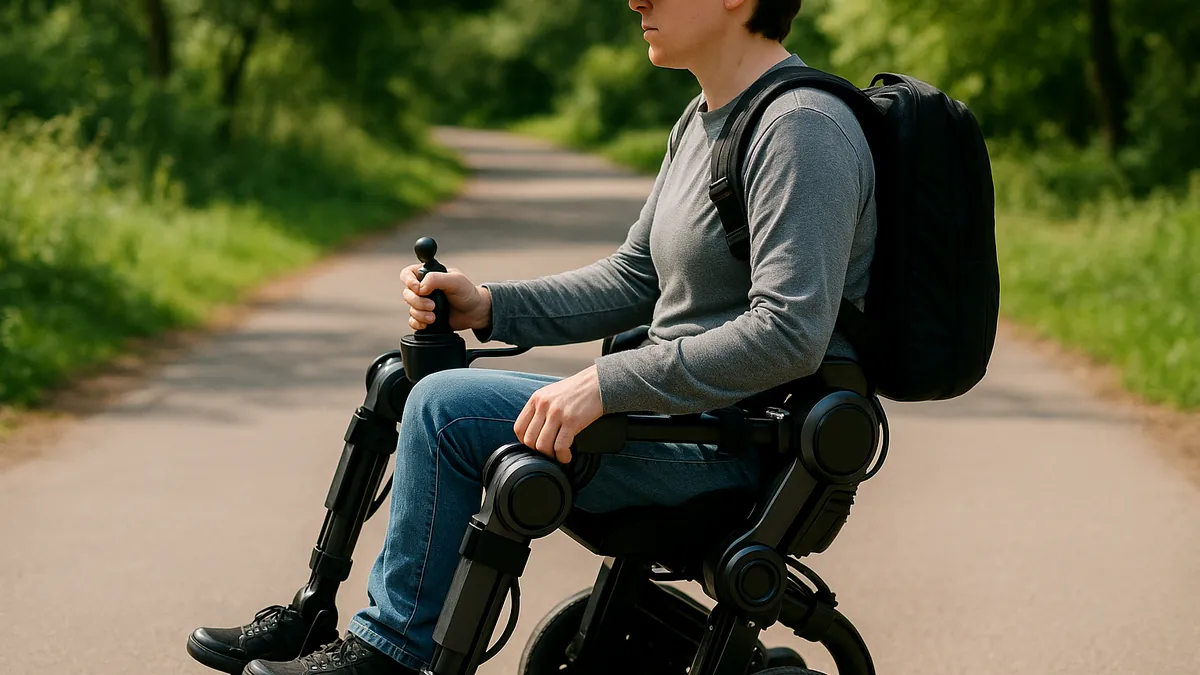
Robert Woo’s 15-year experience as an exoskeleton test pilot matters because it tests a device over time, not in a short demo. In Wandercraft’s self-balancing exoskeleton, the shift is concrete: the suit handles propulsion and balance internally, so the user does not need crutches or arm braces and instead steers with a joystick.
That is a different class of capability from older bulky systems that relied on upper-body support. For a user paralyzed from the chest down, removing the need to constantly stabilize the device changes the practical burden of using it, and it sets a higher bar for control reliability because balance is no longer outsourced to the user’s arms.
Clinical gains come from adapting torque to the person, not from adding generic assistance
Trials of robotic hip exoskeletons using gait phase estimation, or GPE, point in the same direction. These systems adjust hip torque in real time from hip joint data, which lets assistance track the user’s gait cycle instead of applying a fixed pattern.
In elderly patients and people with brain lesions, that dynamic support improved gait speed, cadence, and endurance. The detail that matters for deployment is that users with lower initial mobility benefited the most, which argues for personalization as a core design requirement rather than a later software feature.
That also corrects a common simplification. Exoskeletons are not generic mobility aids that can be tuned lightly for any user; rehabilitation systems have to respond to changing gait phases, uneven baseline ability, and the fact that assistance that helps one patient may destabilize or fatigue another if the controller is poorly matched.
Georgia Tech’s shortcut is about deployment economics as much as AI
A major bottleneck has been controller training. Georgia Tech researchers addressed that by using large datasets of natural human movement to generate functional exoskeleton controllers without collecting new device-specific human-in-the-loop training data for each system.
That matters because controller development has often been slow and expensive in ways that do not show up in prototype videos. If a lab or manufacturer can translate existing movement data into a usable controller, iteration cycles shrink, costs fall, and more device variants become feasible across medical and industrial settings.
The claim should still be kept narrow. Eliminating device-specific data collection is not the same as proving universal real-world robustness; it removes a development barrier, but field deployment still depends on how well those generated controllers handle varied bodies, movement styles, and unexpected conditions once they leave controlled testing.
Pilot exoskeletons face a different failure mode
In aviation, the problem is not simply helping someone walk longer or with less effort. Pilot exoskeletons are being developed to redistribute high-g forces, reduce fatigue, support joints and the spine, and help prevent g-induced loss of consciousness during extreme maneuvers.
That makes biomechanical modeling a first-order requirement. Finite element analysis and load path modeling are needed to decide where forces should travel through the body-device system so support is balanced rather than concentrated in ways that create new strain, discomfort, or control interference.
A fighter pilot exoskeleton therefore cannot be treated as a repurposed rehabilitation frame. It has to preserve precise movement under rapid, multidirectional loads while adding minimal cognitive burden, which is a stricter operating environment and a reminder that exoskeleton design is highly use-case specific.
The next checkpoint is whether these systems can adapt across users and conditions
The current evidence supports a narrower but more useful claim: exoskeletons are moving toward practical deployment where the control stack and biomechanical fit are tailored to a defined job. The next real checkpoint is multi-sensor integration combined with adaptive real-time algorithms that can personalize assistance as the user, terrain, fatigue level, or task changes.
If that layer improves, the field gets closer to deployment beyond curated trials and expert-supervised pilots. If it does not, many systems will remain impressive but narrow, because the remaining constraint is no longer just motors or frames; it is whether the device can sense enough, decide fast enough, and adjust safely enough for the context it is actually used in.
| Use case | What is actually improving | What still limits deployment |
|---|---|---|
| Self-balancing mobility suits | Internal balance and propulsion control, reduced dependence on crutches, more direct user steering | Long-term reliability, safe operation outside controlled settings, user-specific fit and training |
| Rehabilitation hip exoskeletons | Real-time torque modulation with GPE, better speed, cadence, and endurance in target patients | Generalization across patients with different impairments and changing gait patterns |
| AI-generated controllers | Less device-specific data collection, faster controller development, lower iteration cost | Validation across populations, devices, and unpredictable real-world conditions |
| Pilot augmentation systems | Force redistribution under high g, reduced fatigue risk, targeted joint and spinal support | Precise load paths, comfort under extreme motion, zero interference with aircraft control |