









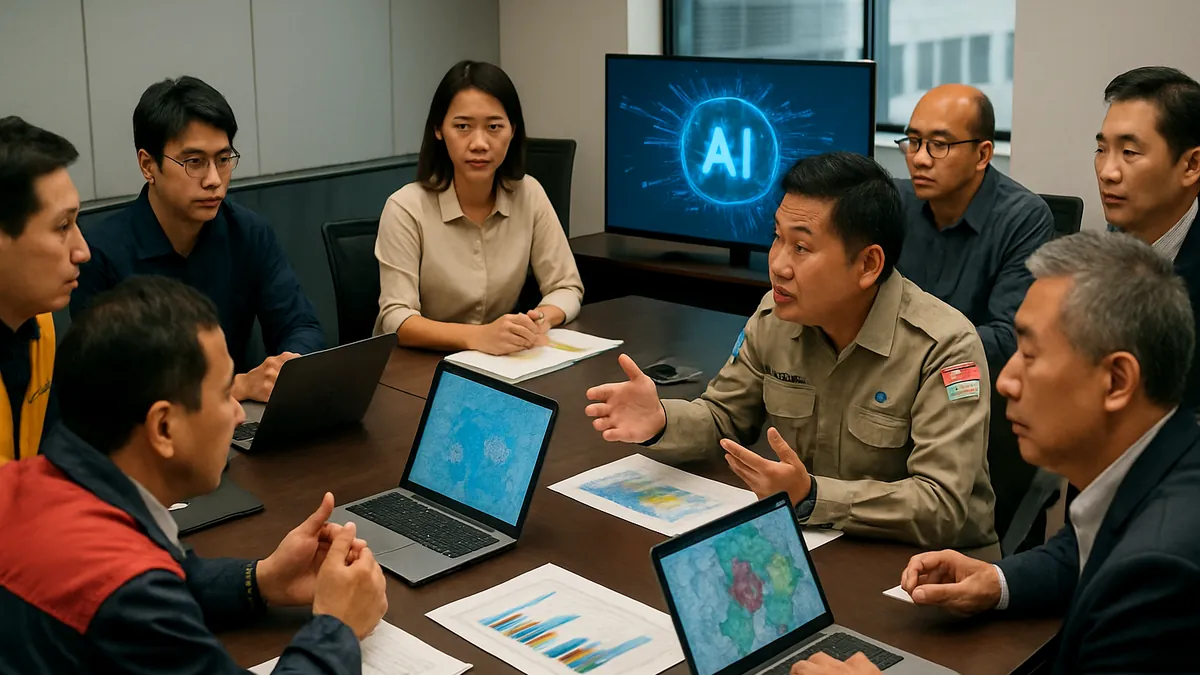
OpenAI’s AI Jam in Bangkok was not an AI awareness exercise. It was a working session aimed at one narrower outcome: deciding where AI can be inserted into disaster response workflows in Asia without breaking accountability, speed, or trust. That distinction matters because the event moved the conversation from ad hoc use of ChatGPT during emergencies toward governed deployment criteria, pilot plans, and workflow-level integration.
Bangkok shifted the discussion from interest to workflow design
The workshop brought together 50 disaster management leaders from 13 Asian countries across government, multilateral, and nonprofit organizations. Instead of centering on general AI literacy, the group worked on reusable GPT-based processes for tasks such as situation reporting, needs assessment, and multilingual public communication. In a region where disasters affect a disproportionate share of the global population, that practical framing is more consequential than another round of conceptual discussion.
The timing also reflects existing behavior, not just institutional ambition. OpenAI said ChatGPT usage rose 17 times during Sri Lanka’s Cyclone Ditwah and 3.2 times during Thailand’s Cyclone Senyar. That suggests responders and the public are already turning to general AI tools during crises, even when formal emergency systems have not yet defined where those tools belong, who checks outputs, or which tasks are safe to accelerate.
The real filter was not capability but task eligibility

The most concrete output from the Bangkok session was a deployment rule: use AI where the task gets a “three times yes.” In practice, that means the work must be repeatable, time-critical, and verifiable. This is a much narrower standard than “AI can help,” and it pushes teams toward functions where automation can save time without quietly increasing operational risk.
That filter fits the kinds of jobs discussed at the workshop. Drafting an initial situation report from hotline traffic, sensor feeds, or field notes is repetitive. Producing a first multilingual public update during an unfolding event is time-sensitive. Both can be checked by human staff before release. By contrast, higher-stakes judgments that are hard to verify quickly, or that depend on uncertain local context, do not meet the same threshold. The point was not to maximize AI coverage inside emergency management, but to identify where AI can sit inside an existing decision chain and remain auditable.
Why the partnership model matters in disaster infrastructure
The workshop’s structure also explains why this was more than a product demonstration. OpenAI supplied model and tooling support; the Gates Foundation contributed funding and a capacity-building lens; the Asian Disaster Preparedness Center brought regional disaster expertise; and DataKind added data operations experience. That combination matters because disaster response systems fail less often from lack of model capability than from weak data access, poor operational fit, unclear ownership, or missing local knowledge.
ADPC’s existing work with geospatial analytics and satellite data is a useful example of the infrastructure layer that generative AI alone does not replace. If an emergency team cannot reliably reach sensor feeds, hotspot reports, or validated field data, a polished language model will only summarize fragmented inputs faster. The Bangkok approach treated AI as one component in a larger stack that includes data pipelines, regional institutions, language coverage, review processes, and frontline training.
Where pilots will succeed or stall
The next phase is pilot deployment inside existing emergency workflows, and that is where the harder questions begin. Teams will need rules for data access, cost control, human approval, training, and audit trails for AI-assisted outputs. In live incidents, those are not administrative side issues. They determine whether an agency can defend a public message, trace the source of a recommendation, and keep operating if connectivity, staffing, or input quality suddenly degrades.
Official agencies also face a new pressure from the outside: if affected communities are already using AI tools for crisis information, public responders are being pushed toward faster and clearer communication in multiple languages. That creates a governance burden as much as a service opportunity. Agencies will need explicit policies on acceptable data sources, known model limits, escalation paths when confidence is low, and the point at which a human reviewer must overrule or rewrite AI output.
| Checkpoint | Operational question | Why it matters in a live disaster |
|---|---|---|
| Three-times-yes test | Is the task repeatable, time-critical, and verifiable? | Prevents agencies from automating work that is too ambiguous or too risky to check quickly. |
| Data access | Can the system reliably pull trusted inputs from hotlines, sensors, field teams, or public channels? | AI outputs degrade fast when source data is partial, delayed, or inconsistent. |
| Human review | Who signs off before information is sent to officials or the public? | Keeps accountability attached to decisions rather than outsourcing it to the tool. |
| Auditability | Can teams reconstruct what inputs and prompts shaped an output? | Necessary for post-incident review, liability, and quality control. |
| Training and cost | Can frontline staff use the tool consistently within budget? | A useful prototype can still fail if the operating model is too expensive or too fragile. |
The next useful signal is not enthusiasm but pilot performance
The main checkpoint now is whether these pilots improve response time and message quality inside real incidents without adding confusion or review bottlenecks. If they work, the Bangkok model becomes a practical template for other sectors with high-stakes, resource-constrained workflows. If they stall, it will likely be because governance, integration, and training proved harder than the model work itself.
That is the clearest way to read the event: not as a regional AI showcase, but as an attempt to define the narrow conditions under which AI can become part of disaster operations in Asia. The important evidence will come from deployment results, especially where pilots show that speed gains survive contact with existing institutions, public-sector controls, and live disaster conditions.