









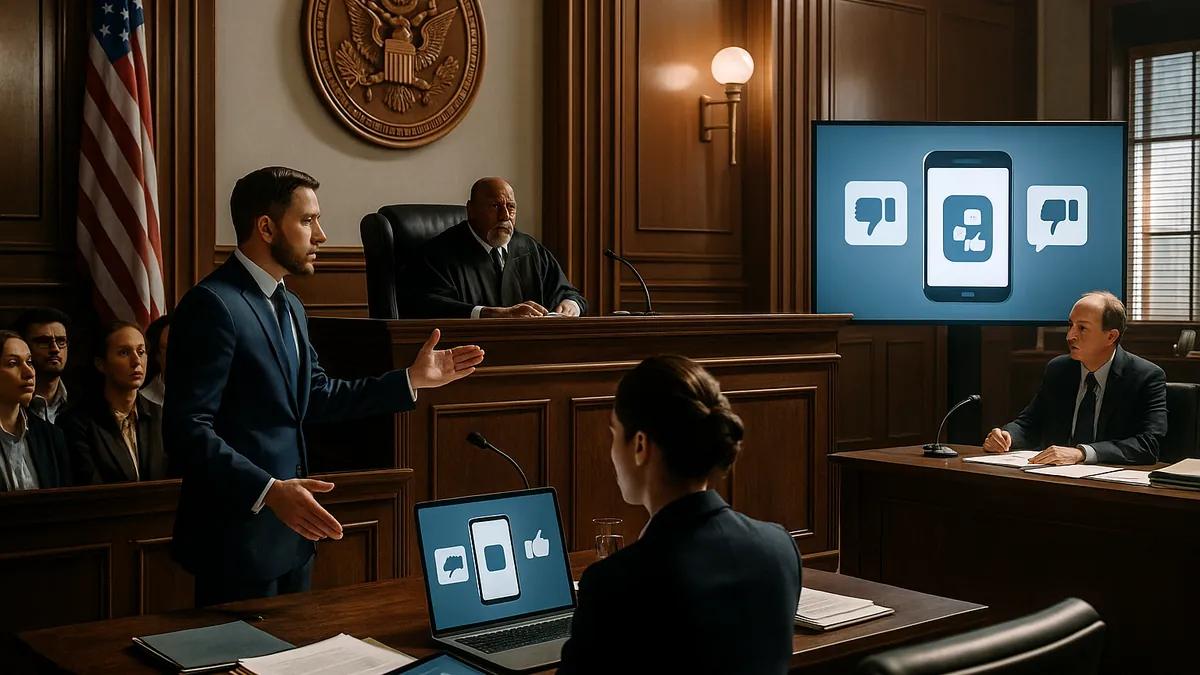
The recent verdicts against Meta and YouTube matter because they shift the legal argument away from harmful posts and toward the way platforms are built to keep people, especially minors, engaged. That is a material change for AI-driven recommendation systems, product teams, and platform governance: the question is no longer just what users upload, but whether the company designed the feed, alerts, filters, and ranking systems to create compulsive use and then hid the risks.
Two jury verdicts changed the frame
In New Mexico, a jury imposed a $375 million penalty on Meta after finding violations of state consumer protection law tied to child safety and mental health harms. Prosecutors argued that the company concealed risks related to child sexual exploitation and psychological damage while putting growth and revenue ahead of protection for young users. Even if that amount is small relative to Meta’s projected 2025 revenue, it is large enough to show that a jury will attach financial liability to platform conduct rather than treat the issue as an abstract policy dispute.
A separate Los Angeles jury went further on the design theory itself. It awarded $3 million in compensatory damages against Meta and YouTube after concluding that addictive platform design contributed to a young woman’s depression and suicidal thoughts. The jury assigned 70% responsibility to Meta and 30% to YouTube, and it found malice, oppression, and fraud. That combination matters because it is not just a finding of negligence; it suggests jurors were persuaded that the companies understood the danger and kept deploying the same engagement systems.
Why Section 230 is not the whole shield here

A lazy reading of these cases says they are another fight over harmful online content. That misses the legal strategy that is making them consequential. Plaintiffs are trying to bypass the usual Section 230 defense by arguing that the injury comes from product design and business incentives: infinite scroll, algorithmic recommendation loops, push notifications, beauty filters, and reward patterns meant to maximize time spent and ad value. If the harm is tied to what the company built and tuned, rather than to a specific post written by a user, the platform’s legal exposure changes.
That distinction is especially important for AI tech because recommendation engines are not neutral plumbing in these claims. They are part of the product theory. In the Los Angeles case, expert testimony linked compulsive use features to reward circuitry effects associated with addiction-like behavior, despite the lack of a formal clinical diagnosis for “social media addiction.” Courts do not need a settled psychiatric label to accept a narrower point: a company can still face liability if it deliberately deploys mechanisms that predictably erode self-control, worsen mental health, and target vulnerable users such as teenagers.
Who should read these rulings as an operational warning
The immediate audience is not just litigators. Product leaders, trust and safety teams, growth teams, ad businesses, school districts, and insurers all have exposure if courts keep treating engagement design as the central risk. The litigation already includes more than 1,600 plaintiffs in consolidated cases, including families and school districts, which means the cost surface extends beyond individual users. Schools are effectively arguing that platform design can create measurable downstream burdens in education and student well-being.
For companies building recommendation systems, the warning is practical: if internal metrics reward session length, reactivation, streak preservation, or high-frequency notifications among minors, those choices may now be discoverable evidence of intent rather than routine optimization. The design features under scrutiny are not obscure edge cases. They are standard retention tools across consumer apps.
How to judge whether a platform is in the danger zone
The safest reading of these rulings is not “all social apps are now liable.” The better reading is that some design and governance combinations are becoming harder to defend, particularly when minors are involved and the company appears to know the risks. The table below is a useful screening lens for operators, regulators, and institutional buyers.
| Condition | Lower legal risk signal | Higher legal risk signal |
|---|---|---|
| Core growth model | Balanced toward utility or subscription value | Heavy dependence on attention capture and ad-driven engagement |
| Youth exposure | Strong age gating and conservative defaults for minors | Weak age verification and broad youth access to high-retention features |
| Recommendation design | User controls, friction, and meaningful opt-outs | Autoplay, endless scroll, aggressive ranking loops, and persistent notifications |
| Internal knowledge | Documented testing, mitigations, and rapid response to harm evidence | Evidence that risks were known, minimized, or hidden |
| Governance posture | Safety reviews can block launches or change metrics | Safety teams advise, but growth metrics still dominate shipping decisions |
The next checkpoint is mid-2026, not someday
The most important near-term marker is the multidistrict litigation scheduled to begin trial in mid-2026. That docket aggregates thousands of claims and will test whether the recent jury reasoning can hold across a broader set of facts, plaintiffs, and platform features. If those trials produce more plaintiff wins or meaningful settlements, companies will have to consider redesign costs, age-assurance changes, insurance pricing, and discovery risk as normal operating constraints rather than exceptional legal events.
For parents and schools, the cases do not replace ordinary safeguards such as device limits, parental controls, and monitoring; they do something different. They increase pressure on platforms to carry more of the burden themselves. For tech firms, the decision lens is straightforward: proceed only if you can show that engagement systems for minors are bounded, auditable, and not dependent on compulsive use patterns. If not, these verdicts suggest the old defense model is weakening.