









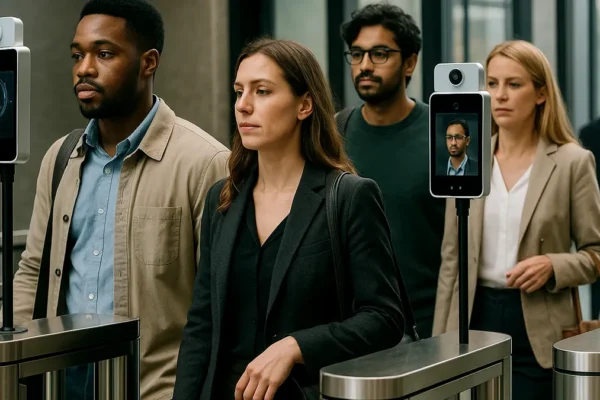
A group of people walking through an office entrance with facial recognition cameras scanning their faces for access control.

Facial Recognition Is Expanding Fast, but Deployment Still Turns on Bias, Privacy, and Local Law

Facial recognition is spreading across security gates, bank onboarding flows, retail systems, and hospitals, but the real story is not universal replacement of older identity checks. The technology works best as a conditional tool: useful for contactless verification and faster screening, yet limited by uneven accuracy, biometric privacy risk, spoofing threats, and country-by-country legal constraints….

Read More
a laptop computer sitting on top of a wooden table

Risk-Aware AI Agents Need More Than Confidence Scores

What changed in agent design is not just better confidence scoring. Uncertainty estimation is being wired into permissions, action gating, and user-facing deferral behavior so agents can do less when the situation is unclear, not merely report lower confidence after the fact. That shift matters in deployment because safety now depends on how uncertainty is…

Read More