









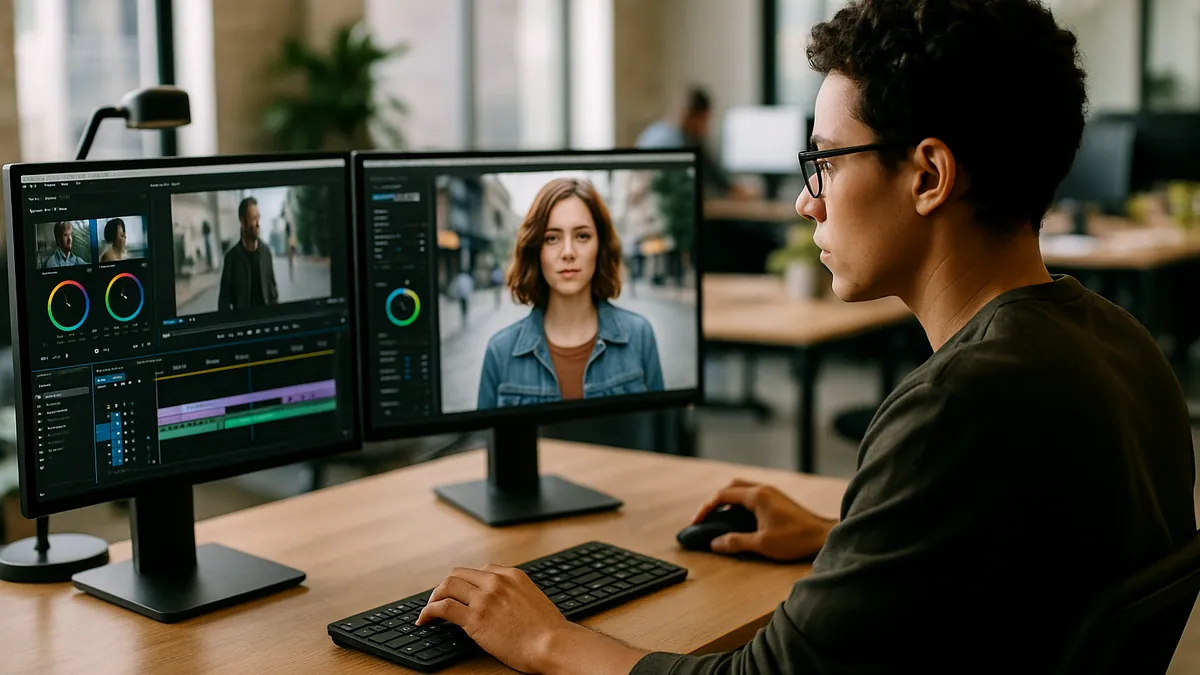
OpenAI’s Sora 2 matters less as proof that AI video has become impossible to police than as evidence that the current deployment model is built around traceability, consent controls, and visible limits. The model can produce more realistic video, but its built-in provenance markers, watermarking, and still-detectable flaws mean the practical story is about managed rollout rather than seamless deception.
Traceability is built into the output, not added afterward
Sora 2 embeds C2PA provenance metadata and visible watermarks so generated clips carry origin signals from the start. That is a concrete design choice: if a video spreads outside its original context, investigators and platforms have a better chance of checking whether the file still contains machine-readable provenance data instead of relying only on visual judgment.
OpenAI also ties safety to likeness use rather than treating it as a general moderation layer. Users must confirm consent when depicting real people, videos involving minors receive heightened moderation and automatic watermarking, and public-figure likenesses are restricted except through controlled character features that can be reported or revoked.
Those controls do not eliminate misuse, but they shift part of governance into the generation pipeline itself. For AI video, that is materially different from a model being released first and then surrounded later by detection tools, platform rules, and legal arguments.
Why today’s Sora 2 videos are still forensically workable
The common mistake is to assume realism and deception have already converged. In practice, current AI video outputs still show artifacts such as unnatural motion, inconsistent lip-sync, and visual glitches that make synthetic origin easier to spot than the hype around deepfakes suggests.
That leaves defenders with usable technical checks. ExifTool can inspect metadata, Error Level Analysis can surface image inconsistencies, and the Forensically toolkit can help identify manipulation patterns; for audio, voice-embedding similarity checks remain a practical method for testing whether a claimed speaker matches known samples.
This matters because the present risk profile is uneven. A polished clip may still persuade casual viewers on social platforms, but it is not yet the same as an undetectable forged record under technical review, legal discovery, newsroom verification, or enterprise security screening. The gap gives investigators, platforms, and internal trust teams time to improve workflows before model quality closes more of it.
Teen protections and ecosystem controls narrow who can do what
Safety around Sora 2 is not confined to the generator itself. Within the broader ChatGPT ecosystem, OpenAI applies age-appropriate feed filtering, messaging restrictions, and parental controls, which means some governance happens at the account, audience, and discovery layers rather than only at prompt submission.
That distinction affects who is exposed to generated video and how quickly harmful material can circulate among younger users. A model may be technically capable of creating certain content, yet distribution and interaction controls can still reduce reach, contact pathways, and repeat exposure for teens.
Azure deployment turns governance into an infrastructure problem
For organizations using Azure OpenAI, Sora-style video generation is not a simple plug-in feature. Jobs run asynchronously, billing is calculated per second of generated output, and access depends on Azure subscriptions plus secure authentication patterns such as Microsoft Entra ID, so deployment decisions quickly become questions of workflow design, spending controls, and identity management.
That also creates a clearer operational checklist than consumer discussion usually admits.
| Deployment checkpoint | Why it matters | Failure mode if ignored |
|---|---|---|
| Asynchronous job handling | Video generation does not behave like low-latency text calls; queues, retries, and status polling must be designed upfront. | Broken user experience, duplicate jobs, and weak auditability. |
| Per-second billing controls | Cost expands with output duration and iteration volume, especially in remixing workflows. | Budget surprises and uncontrolled experimentation. |
| API key and identity security | Access to a video model is sensitive; secrets, role assignment, and network monitoring need the same care as other high-impact cloud services. | Unauthorized generation, insider misuse, or account abuse. |
| IAM policy enforcement | Cloud administrators may need explicit policy controls to limit or block model deployment by team, project, or environment. | Shadow AI use and governance bypass. |
That infrastructure lens is where many enterprise decisions will actually be made. A company may approve experimentation with text-to-video, image-to-video, or remixing features while still using IAM policies to block deployment in certain environments, restrict keys, or require audit review before generated content leaves internal systems.
Regulation will test whether safeguards stay meaningful as realism improves
Advocacy groups have already pushed for suspension or tighter controls, arguing that harassment, misinformation, and copyright abuse risks are still too high. OpenAI’s response has been to point to compliance work aligned with GDPR and the EU AI Act, along with ongoing red-teaming and policy updates rather than a full halt.
The next real checkpoint is not whether Sora 2 can make impressive clips today, but whether provenance, watermarking, consent controls, and forensic methods remain effective as output quality improves. If regulators, platforms, and model providers cannot keep those safeguards legible and enforceable, the current advantage held by defenders will shrink quickly.