








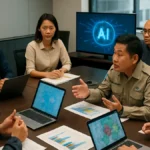

OpenAI has unveiled GPT-5.4, a significant advancement in AI technology that promises to redefine knowledge work and our interactions with software. This release is particularly timely as competition heats up with new models from Anthropic and Google, making its potential implications for professional workflows crucial to understand.
Summarizing the Advancements of GPT-5.4
GPT-5.4 introduces groundbreaking features that enhance its functionality beyond mere text generation. Its ability to execute commands and verify results represents a shift towards more autonomous systems capable of engaging in a dynamic feedback process. This build-run-verify-fix cycle is essential for complex tasks, allowing users to refine outputs efficiently.
Moreover, the model’s expanded context window, which accommodates up to one million tokens, is a game-changer for professionals dealing with large datasets. This capability enables thorough analysis of extensive documents or codebases in a single request, significantly reducing the time spent on repetitive tasks.
Explaining the Causes Behind AI Integration Challenges
Despite the technological advancements of GPT-5.4, integrating such sophisticated AI into existing workflows poses significant challenges. Organizations must invest not only in the technology itself but also in training their workforce to effectively leverage these new capabilities. This dual requirement can strain resources and complicate the adoption process.
Additionally, the fear of job displacement in sectors heavily reliant on knowledge work adds another layer of complexity. As AI systems take on more complex tasks, the concern about their impact on employment becomes increasingly pressing, necessitating a careful approach to integration.
Analyzing the Impact on Professional Workflows
The implications of GPT-5.4 extend beyond individual users, influencing broader industry dynamics. Companies integrating AI models into their operations may need to reconsider their workforce strategies. This could involve retraining employees, restructuring teams, or redefining job roles to align with AI capabilities.
Such changes could foster a more adaptable workforce, but they also require careful management to avoid disruption. The balance between embracing innovation and maintaining operational stability is crucial for organizations navigating this transition.
Furthermore, the model’s improvements in reasoning and factual accuracy—reportedly generating false claims 33% less often than its predecessor—are particularly noteworthy. This enhancement is vital for users relying on AI for accurate information, reinforcing the importance of critical thinking and emotional intelligence in professional settings.
Describing the Consequences of GPT-5.4’s Release
As organizations begin to weave AI models like GPT-5.4 into their operations, they will likely face practical constraints that could hinder effective implementation. Factors such as industry-specific requirements and existing technological infrastructure will significantly influence how well the model integrates into professional settings.
The absence of clear implementation guidelines often hampers the effective use of advanced AI systems, leading to inconsistent applications and suboptimal outcomes. Organizations must navigate these challenges to fully realize the benefits of GPT-5.4.
Projecting the Future Implications of AI in Knowledge Work
The landscape of knowledge work is evolving rapidly with innovations like GPT-5.4. Companies may find themselves in a continuous cycle of innovation, striving to keep pace with advancements in AI technology. This dynamic could present both opportunities and challenges as organizations work to leverage AI’s benefits while managing associated risks and uncertainties.
Ultimately, the launch of GPT-5.4 marks a pivotal moment in AI technology, particularly concerning its application to knowledge work and agentic tasks. However, its successful adoption demands a nuanced approach to balance enhanced efficiency with the complexities it introduces.
What are the main features of GPT-5.4?
GPT-5.4 features advanced command execution, result verification, and a dynamic feedback process known as build-run-verify-fix. It also boasts an expanded context window that accommodates up to one million tokens, allowing for comprehensive analysis of large datasets in a single request.
What challenges do organizations face when integrating GPT-5.4?
Organizations face challenges such as the need for significant investments in both technology and workforce training. Additionally, concerns about job displacement and the absence of clear implementation guidelines can complicate the integration process, leading to inconsistent applications of the technology.