








Humanoid robots are no longer being judged only by dance clips or balance demos. Agility Robotics’ Digit is now being deployed through commercial agreements and a field-tested rollout process, making the real question less about whether the robot can move impressively and more about whether it can keep a facility running safely, reliably, and at acceptable cost.
Digit’s shift from prototype to deployed system
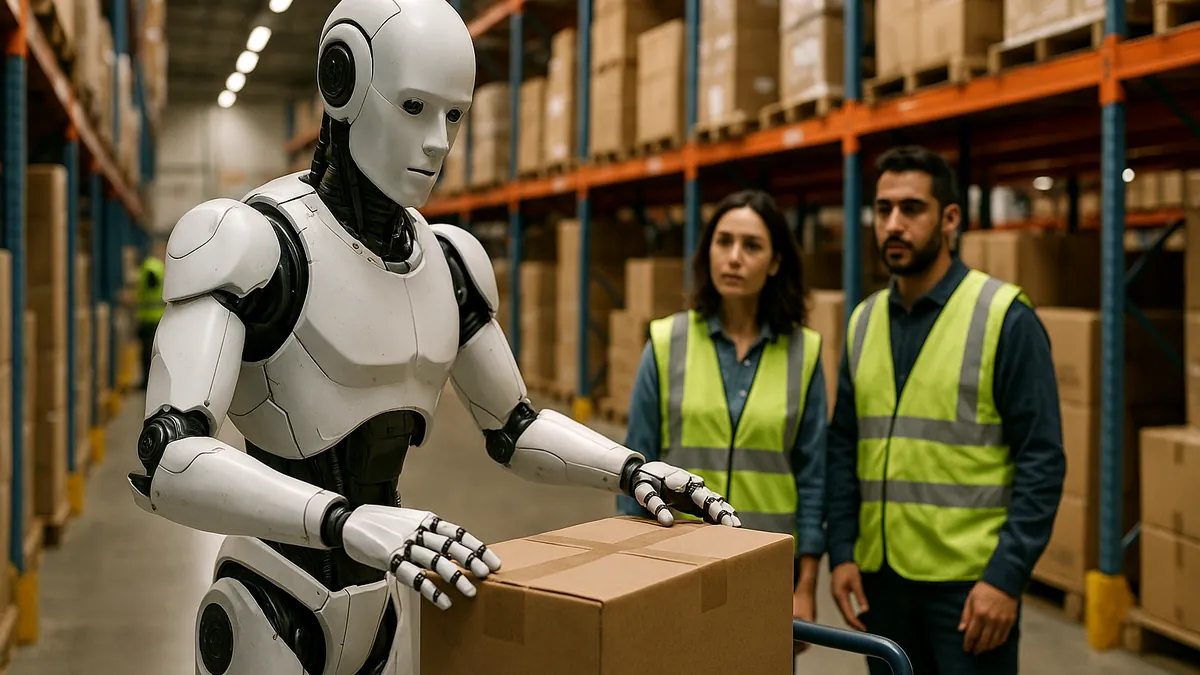
Agility Robotics has moved Digit into production-oriented use with a clearer industrial posture than many humanoid projects still centered on research footage. The company says Digit runs on its Arc cloud platform, which is designed to let facilities mobilize robots quickly and connect them to existing workflows instead of treating each deployment as a custom experiment.
That distinction shows up in the customer list. Agility has commercial agreements with Toyota Motor Manufacturing Canada and Mercado Libre, two names that matter because they point to logistics and material-handling use cases where uptime, throughput, and safety checks matter more than novelty.
Agility is also trying to remove a common deployment risk before the robot even reaches a customer site. Digit is assembled in Oregon, and roughly 80% of its nearly 6,000 parts are sourced in the US, a supply-chain decision that reduces exposure to component delays and makes scaling more plausible than it would be for a robot dependent on a fragile global parts chain.
Why flashy videos can still be useful evidence

Robot dance videos are easy to dismiss as marketing, but that misses what they can actually reveal. If a humanoid can learn coordinated movement quickly, maintain balance, and adjust in real time, those are the same control qualities needed for repetitive industrial tasks in spaces built for people.
Boston Dynamics offers a useful comparison. When Spot performs three consecutive backflips, the interesting part for deployment is not the spectacle itself but the underlying stability, body control, and autonomous recovery behavior that can matter in an unpredictable environment. A robot that can recover from a fall without waiting for human help has a direct operational advantage over one that merely looks impressive in a carefully staged demo.
The correction is straightforward: videos should not be treated as proof of market readiness, but they also are not meaningless entertainment. They are partial evidence of locomotion quality, sensing, and control robustness, and those traits become relevant only when paired with integration, support, and safety validation on real sites.
Deployment reality is a checklist, not a press release
Agility’s message around Digit is notable because it emphasizes validation and support rather than only capability claims. A field-proven deployment process with on-site checks and ongoing operational support suggests the company understands that industrial buyers are purchasing continuity, not a robotics narrative.
For that reason, the practical comparison is less “humanoid versus non-humanoid” and more “demo-grade system versus operational system.” A robot becomes operational when it can be introduced into a facility without breaking throughput, when staff can predict its behavior around routine exceptions, and when the vendor can keep parts, software, and support aligned over time.
| Checkpoint | Demo signal | Production signal |
|---|---|---|
| Movement quality | Dance routines, flips, balance clips | Stable task execution in normal facility traffic and repeated shifts |
| Recovery behavior | Controlled test resets | Autonomous recovery from slips, falls, or interruptions |
| Integration | Standalone performance | Connection to workflow software, facility processes, and support systems through platforms such as Arc |
| Supply chain | Prototype sourcing tolerated | Domestic or resilient sourcing that can sustain repairs and expansion |
| Customer confidence | Interest driven by novelty | Commercial agreements tied to throughput, labor gaps, and measurable return |
The older computing lesson that still applies
There is a useful historical frame for reading this stage of robotics. Computing pioneers such as John Mauchly and Kathleen McNulty worked in an era when early machines were understood through use, adaptation, and unexpected behavior, not just through initial design specifications.
That matters because humanoid systems are still revealing their actual value in operation. Their capabilities do not stop at what a launch video shows, but neither do they become meaningful merely because the technology is sophisticated; the test is whether repeated use in a live environment exposes a reliable role that justifies deployment and ongoing support.
What industrial buyers should watch next
The next checkpoint is not whether humanoid robots can do more tricks. It is whether robots like Digit can expand across different industrial environments while maintaining safety compliance, stable economics, and enough flexibility to handle routine variation without expensive reconfiguration.
That puts pressure on several things at once: cost per task, incident rates, integration time, and vendor support depth. A deployment that works in one logistics setting will not automatically transfer to another, so each new site becomes a verification step for whether humanoid automation is becoming infrastructure or remaining a narrow pilot.
If Digit continues to scale through partners such as Toyota Motor Manufacturing Canada and Mercado Libre while keeping its supply chain and support model intact, that will be a more meaningful signal than any viral robot video. The material change is not that humanoid robots can move elegantly; it is that some of them are now being asked to justify themselves inside production systems.