








Lucid’s Lunar reveal is important less as a product launch than as a cost-and-platform signal: the company wants its upcoming midsize EV architecture to serve both consumer cars and future autonomous fleets. That could matter to Uber and other fleet operators if Lucid can turn its efficiency claims into a manufacturable robotaxi, but the gap between concept and deployable vehicle is still the main story.
A robotaxi concept built to reuse Lucid’s midsize EV base
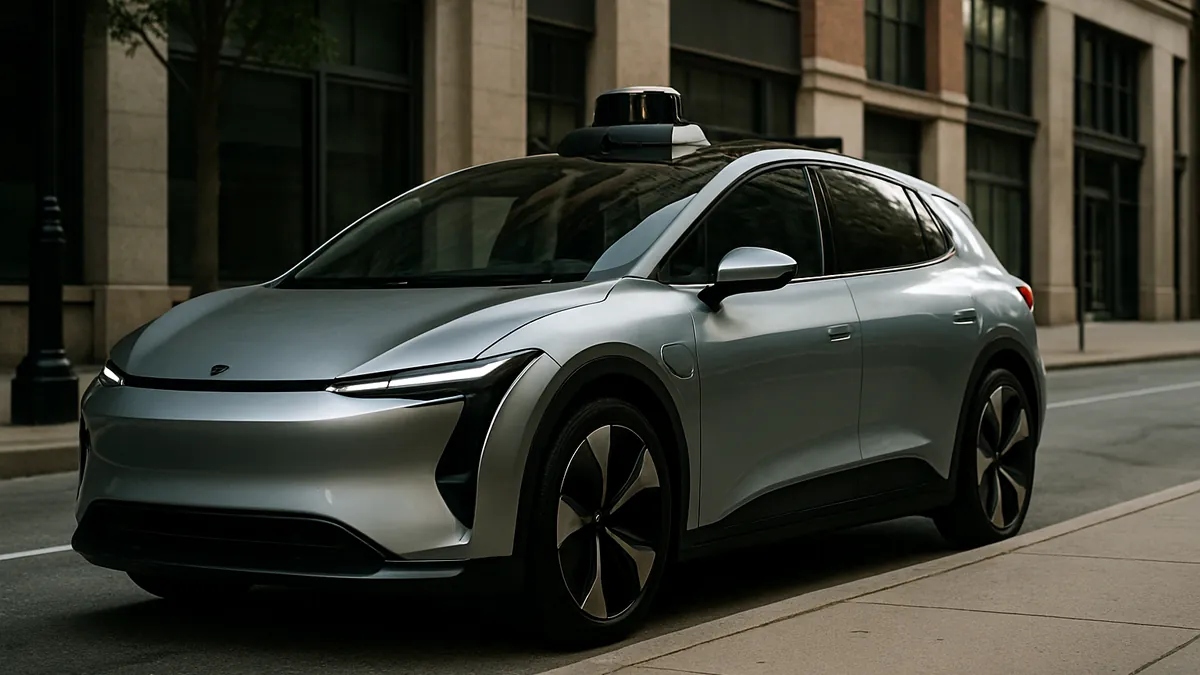
At an investor day event in New York, Lucid showed Lunar as a two-seat robotaxi concept with no steering wheel and no pedals. It is based on the same upcoming midsize platform that Lucid says will also underpin consumer vehicles including the Lucid Cosmos and Lucid Earth, which makes the concept strategically different from a one-off show car.
That shared-platform approach is the clearest practical point in Lucid’s pitch. If the same base architecture can support personal EVs and ride-hailing vehicles, Lucid could spread development and manufacturing costs across more units, while giving commercial partners a vehicle designed around fleet economics rather than retrofitting a consumer car for robotaxi use.
Lucid is selling efficiency and utilization before it can sell a vehicle
Lucid says Lunar would deliver 5.5 to 6.0 miles per kWh and recover more than 200 miles of range in roughly 14 to 15 minutes. Those numbers are aimed directly at the hardest deployment reality in robotaxis: a fleet only works economically when vehicles spend more time carrying passengers and less time charging, waiting, or being serviced.

Marc Winterhoff, Lucid’s interim CEO, also framed the cabin around turnover and operating simplicity. The concept uses two forward-facing passenger seats, easier ingress and egress, and a front luggage compartment that avoids a conventional trunk interaction, all of which are small design choices that matter more in high-frequency commercial use than they do in a private car.
Lucid’s headline claim is that Lunar could cut operating costs by about 40% versus current robotaxi fleets. That is a meaningful target because many early robotaxi deployments have been constrained not just by autonomy maturity, but by expensive vehicle platforms, charging downtime, and hardware stacks that make every mile hard to monetize. The catch is that Lucid has not provided a production cost, bill of materials, or confirmed fleet specification, so the savings claim is still a strategic argument rather than a commercially validated number.
Why the Uber angle matters more than the concept rendering
Lucid is in discussions with Uber about deploying robotaxis built on its midsize platform at scale, potentially in volumes comparable to the 20,000-unit Gravity SUV robotaxi program already planned. Uber COO Andrew Macdonald has said the company is interested, but final specifications and deployment details remain under negotiation, which is a reminder that platform interest is not the same thing as a signed fleet program.
That distinction matters because the likely buyer for something like Lunar is not a retail customer but an operator making utilization, maintenance, charging, and financing decisions all at once. For Uber, the question is not whether a two-seat, control-free vehicle looks futuristic; it is whether Lucid can deliver a reliable platform with known service intervals, predictable energy performance, and enough production capacity to support a real network rollout.
The autonomy timeline does not put Lunar on the road next year
One easy misreading is to treat Lunar as if it were already in active development for near-term production. Lucid has not confirmed that, and it has not announced a launch date or manufacturing plan for Lunar itself.
The company’s own roadmap is staged and slower than the concept imagery might suggest. Lucid expects hands-free highway driving in 2026, hands-free highway and city driving in 2027, Level 3 autonomy in 2028, and Level 4 autonomy in 2029. That means Lunar should be viewed as a future application of Lucid’s autonomy stack, not as proof that a production-ready robotaxi is imminent.
| Item | Lucid says | What is still unresolved |
|---|---|---|
| Vehicle status | Lunar is a two-seat robotaxi concept on the midsize EV platform | No confirmed production timeline or factory plan |
| Efficiency | 5.5 to 6.0 miles per kWh, 200+ miles added in about 15 minutes | No real-world fleet validation data yet |
| Operating cost | About 40% lower than current robotaxi fleets | No disclosed manufacturing cost or full operating model |
| Autonomy path | Hands-free features from 2026, Level 4 targeted for 2029 | Regulatory, technical, and deployment milestones remain ahead |
| Commercial partner | Uber discussions are active | Final specs, volumes, and launch timing are not set |
The next real checkpoints are specs, cost targets, and a signed deployment plan
Lucid also plans to sell autonomy as software, with DreamDrive Pro subscriptions ranging from $69 to $199 per month starting in the first half of 2027. That may become a meaningful revenue stream for consumer vehicles, similar in logic to Tesla and Rivian, but it does not answer the harder robotaxi question of who owns the vehicle economics once there is no driver in the loop.
Lunar will become commercially relevant only when Lucid and Uber, or another partner, disclose final vehicle specifications, target costs, and a deployment structure that connects autonomy capability to fleet operations. Until then, the useful reading is straightforward: Lucid has laid out a credible direction for a cheaper, more efficient robotaxi platform, but not yet a product that fleet operators can schedule, finance, and deploy.