








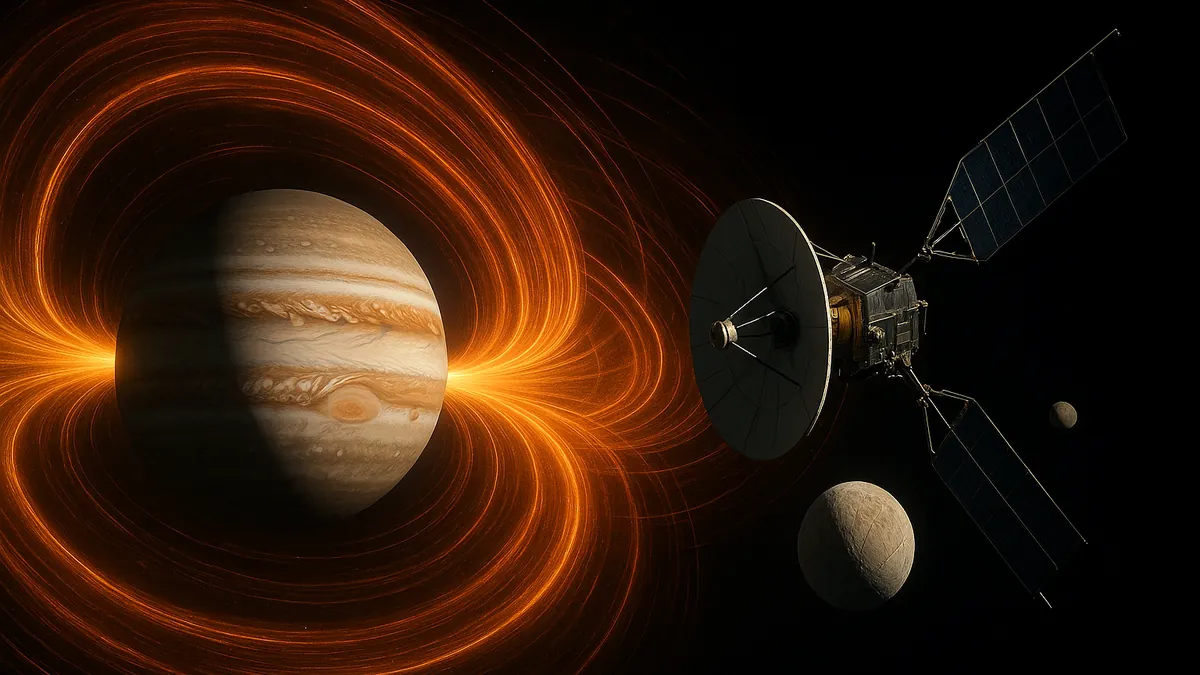
Jupiter mission planning is no longer based on a simple assumption that its radiation belts are just a larger, harsher version of Earth’s. For ESA’s Juice mission, the decisive shift is that newer measurements, especially from Cassini’s 2000 flyby, point to a more uneven and in some ways more dangerous electron environment than older expectations suggested, forcing spacecraft designers to rely on detailed modeling, selective shielding, and route choices rather than raw hardening alone.
Who needs the full Jupiter radiation treatment
The strongest fit is any mission that will spend meaningful time inside Jupiter’s magnetosphere, particularly near the equatorial regions where trapped particle fluxes rise sharply. Juice, headed to the icy moons, falls into that category, which is why ESA built the JOvian Specification Environment, or JOSE, from Pioneer, Voyager, Galileo, and Cassini data to estimate electron and proton exposure across different paths and mission phases.
This matters even more for Europa concepts. Europa’s orbit sits inside one of the most radioactive parts of the system, so an orbiter or lander there cannot treat radiation as a secondary engineering problem. It has to shape the vehicle architecture, the component list, the shielding mass budget, and the time spent in the worst zones.
Why the old Earth analogy breaks down
A common shortcut is to describe Jupiter’s belts as scaled-up Van Allen belts. That misses the operational problem. Jupiter’s magnetosphere stretches roughly 20 million kilometers and is fed not only by the solar wind but also by material from Io’s volcanism, creating a particle environment that is not uniform, not steady in a simple way, and not adequately captured by broad comparisons with Earth.
Cassini’s flyby made the mismatch concrete. Its radio measurements indicated fewer of the very highest-energy electrons than some earlier estimates had implied, but many more electrons at slightly lower energies. Those particles are still energetic enough to damage electronics and materials, so the net hazard did not ease; in practice, it became harder to simplify. A mission designed around only the peak-energy tail could underprotect itself against the larger population that actually delivers damaging dose and upset risk.
How Juice turns the model into hardware choices
JOSE is not just a scientific description of Jupiter’s environment; it is a design tool. It lets planners compare trajectories and reduce exposure by avoiding orbital geometries, including low-latitude passes, where particle intensity is highest. That is the difference between a mission that survives for years and one that carries unnecessary radiation burden from the start.
Protection then moves from software charts into physical structure. Juice places sensitive electronics inside lead-reinforced vaults and adds spot shielding with materials such as tantalum where specific components need extra protection without pushing total mass too high. That selective approach reflects a real spacecraft trade-off: every added shield layer improves survival margins, but every kilogram also constrains propulsion, instruments, and mission flexibility.
Component screening is equally practical. ESA engineers used medical radiation beam facilities to simulate the effects of Jupiter-like exposure on both commercial and space-grade parts, looking for vulnerability to single event upsets and cumulative total ionizing dose. Where shielding cannot eliminate the risk, the system has to absorb faults through redundancy, including techniques such as triple modular redundancy in hardware and software.
Proceed, adjust, or avoid: the mission design thresholds
| Mission condition | Recommended posture | Why |
|---|---|---|
| Brief or distant operations in Jupiter space | Proceed with model-based margining | Exposure is still serious, but trajectory choice can remove much of the avoidable dose. |
| Multi-year mission near major moons | Proceed only with shielding, hardened parts, and upset-tolerant design | Cumulative dose and repeated transient errors become central life-limiting factors. |
| Europa orbiter or lander | Adjust architecture aggressively | Europa remains inside a highly radioactive zone, so shielding and mission duration become first-order constraints. |
| Deep entry into the most intense inner belts or Jupiter interior/atmosphere concepts | Avoid or redesign unless the radiation case is revalidated | Cassini showed that assumptions can miss the damaging part of the spectrum; underestimating electrons is a mission-ending error. |
The practical warning sign is any design review that treats Jupiter radiation as a single headline number. Mission survival depends on particle species, energy distribution, latitude, time spent in specific zones, and how those factors interact with real components. If those are collapsed into a generic “Jupiter is harsh” assumption, the shielding plan is probably too crude.
RADEM is the next checkpoint, not a footnote
Juice carries the Radiation Hard Electron Monitor, RADEM, to measure conditions in situ and test how well JOSE matches the environment the spacecraft actually meets. That matters because Jupiter mission design is still model-dependent in places where direct sampling has been limited, and Cassini already showed that a new dataset can materially change the engineering picture.
For future missions to Jupiter’s moons, RADEM’s value is not abstract. If it refines exposure maps, confirms where current margins are conservative, or identifies regions where they are not, it will affect shielding requirements, component qualification standards, and whether certain orbits are worth the risk at all. The main lesson from Juice and Cassini together is straightforward: at Jupiter, the design problem is not just extreme radiation, but radiation detail that can punish oversimplified planning.