







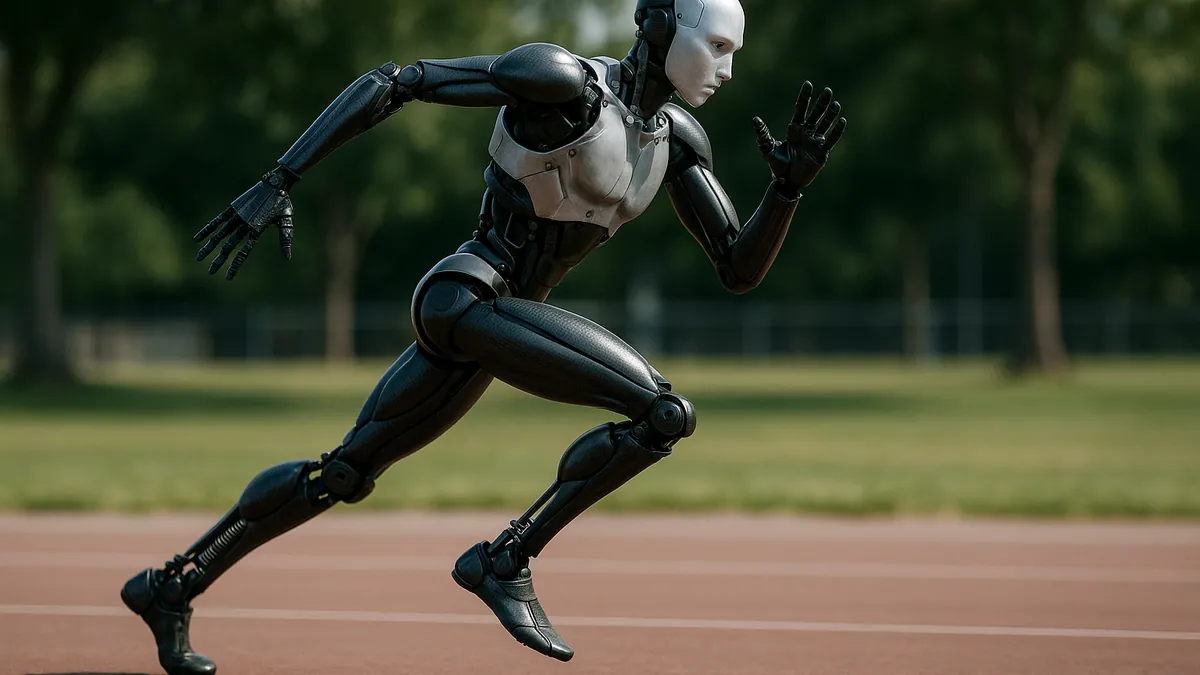
MirrorMe Technology’s new humanoid robot Bolt matters because it moves the discussion past “can a robot run fast?” and into a harder deployment question: what has to be true before a human-shaped machine running at 22 mph can work safely outside a controlled test. In MirrorMe’s trial, Bolt reached 22 mph, or about 10 meters per second, while keeping dynamic balance at a body size close to an average adult human—about 5 feet 7 inches and 165 pounds.
Why Bolt is different from a stunt demo
Speed alone would be easy to dismiss as a headline exercise if Bolt relied on an unrealistic frame or a one-off sprint with poor control. The more consequential detail is that MirrorMe says the robot combines human-like proportions with stable high-speed locomotion. Its build uses carbon fiber limbs, spring-assisted joints, high-torque actuators, and impact-resistant legs, a package aimed at absorbing repeated loads while keeping stride rhythm fast and controlled rather than simply forcing longer, riskier steps.
That corrects a common misreading in humanoid robotics. High-speed running in a human form is not only a spectacle problem; it is a control problem, a materials problem, and a safety problem. A machine that can accelerate, recover balance, and manage impact at this speed starts to become relevant for athletic training, emergency response, and certain industrial tasks—but only if the same control holds up beyond a short, staged run.
The lineage behind the 22 mph mark
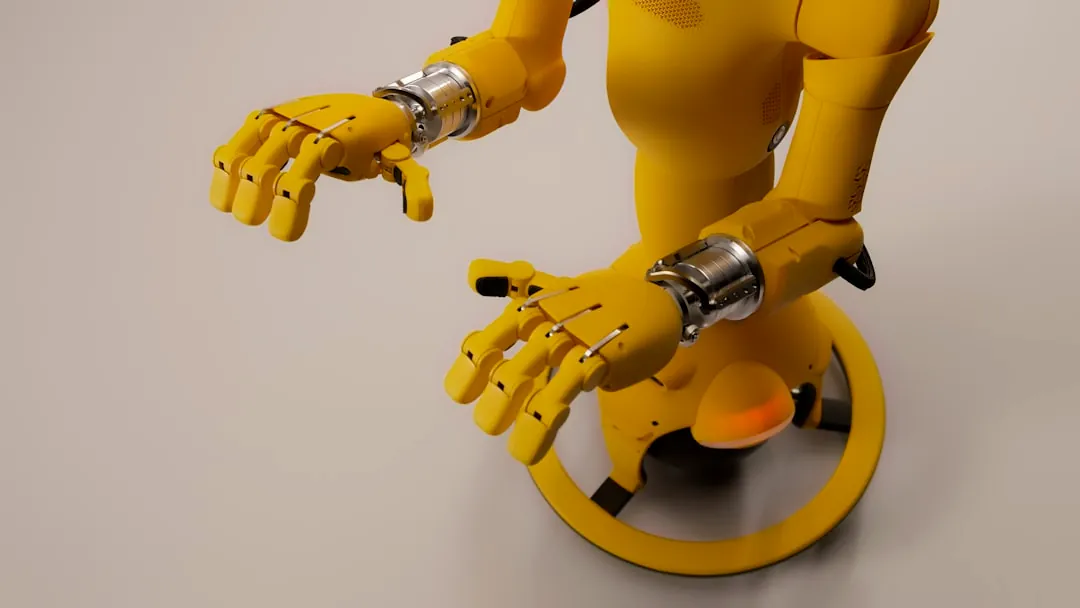
Bolt did not appear from nowhere. MirrorMe has reportedly pursued speed-focused robotics since 2016, and Bolt builds directly on the company’s Black Panther quadruped, which set a 22-plus mph speed record in 2025. That matters because it suggests the company is transferring lessons from high-speed legged motion—materials choice, drive systems, and control algorithms—from a four-legged platform into a more difficult bipedal one.
Bipedal running is the harder problem. A quadruped can distribute forces and recover from instability across more contact points; a humanoid has much narrower margins at speed, especially when its shape is intentionally close to human size. MirrorMe’s engineering choices point to that trade-off: lighter limbs reduce inertia, spring assistance improves energy return, and high-torque actuation helps recover posture quickly enough to avoid a collapse during acceleration or foot strike. Those are the mechanisms that make the 22 mph figure more than a publicity number.
Where the field still falls short
Other Chinese robot projects show why Bolt is a step forward but not a complete deployment-ready answer. In a recent half-marathon, Tiangong Ultra finished in 2 hours and 40 minutes, but it needed battery swaps and occasional human balance assistance. That result is useful precisely because it exposes what speed demos often hide: endurance, power logistics, and autonomy remain separate bottlenecks.
Unitree Robotics’ G1 Bionic robot illustrates a different trade-off. It runs at about 4.5 mph, far slower than Bolt, but uses 3D lidar, depth sensing, and force-controlled joints to adapt to terrain. In other words, one path is pushing top-speed locomotion, while another is prioritizing perception and stability on uneven surfaces. For real-world deployment, especially near people, the slower but more situationally aware system may still be the more usable one today.
The checkpoint for using fast humanoids near people
The next threshold is not whether Bolt can go faster than previous humanoids. It is whether a robot moving at this speed can sustain operation, navigate without human correction, and follow safety rules in spaces that are not engineered around it. Extended high-speed operation raises immediate questions about battery duration, repeated impact wear, stopping distance, obstacle handling, and what happens when perception or balance degrades mid-run.
If a buyer is evaluating this class of robot, the decision lens is straightforward: proceed only when speed is matched by endurance data, autonomous navigation performance, and operational safeguards. A fast humanoid may fit controlled athletic training first, where routes, participants, and supervision are constrained. Emergency or industrial deployment is a higher bar because the robot would need reliable behavior under uncertainty, not just impressive mechanics under ideal conditions.
| System | Reported capability | Strength | Current limit |
|---|---|---|---|
| MirrorMe Bolt | 22 mph top speed in controlled testing | Human-scale high-speed locomotion with balance control | Endurance, autonomous navigation, and safety validation in open environments |
| Tiangong Ultra | Half-marathon in 2h40m | Longer-duration operation demonstrated in competition | Needed battery swaps and human balance assistance |
| Unitree G1 Bionic | About 4.5 mph running speed | Terrain adaptability through lidar, sensing, and force-controlled joints | Much lower speed than Bolt |
Who should pay attention now
Teams working on sports technology, industrial robotics, and emergency systems should treat Bolt as a capability signal, not as proof that high-speed humanoids are ready for broad rollout. The material change is that a human-sized biped has now crossed a speed threshold that used to belong mostly to non-humanoid platforms. That shifts the engineering agenda toward runtime, navigation stack quality, and governance for operation near workers or the public.
Regulators and site operators will eventually face a practical classification question as well: whether a fast-running humanoid is governed like a mobile industrial machine, a service robot, or something closer to a new category of autonomous physical system. Until those rules and operating protocols are clearer, the safest assumption is that Bolt’s 22 mph record is a major locomotion advance—but still one checkpoint short of routine real-world deployment.