









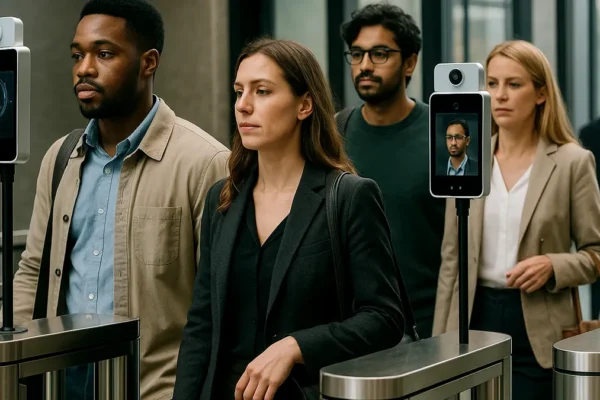
A group of people walking through an office entrance with facial recognition cameras scanning their faces for access control.

Facial Recognition Is Expanding Fast, but Deployment Still Turns on Bias, Privacy, and Local Law

Facial recognition is spreading across security gates, bank onboarding flows, retail systems, and hospitals, but the real story is not universal replacement of older identity checks. The technology works best as a conditional tool: useful for contactless verification and faster screening, yet limited by uneven accuracy, biometric privacy risk, spoofing threats, and country-by-country legal constraints….


Read More
A computer programmer working intently on coding with multiple screens showing code and game interfaces in an office setting.

LLMs Do Not Succeed in Games by Default. The Benchmark and API Layer Is Doing Much of the Work

Recent game-playing results from large language models are easy to overread. The stronger finding is not that LLMs can simply be dropped into games, but that their performance changes sharply when researchers add task-specific evaluation harnesses, game interfaces, and supporting modules that compensate for weak planning, action formatting, or memory. LMGAME-BENCH shows the gap between…

Read More
Industrial office workers collaborating at desks with computers and documents in a manufacturing company office.

STADLER’s ChatGPT Rollout Shows Where Industrial AI Is Landing First: Office Work, Not the Factory Floor

STADLER, a 230-year-old industrial manufacturer with 650 employees, is offering a clearer signal about enterprise AI adoption than many larger pilot programs: generative AI is moving into traditional companies first through knowledge work, not through full automation of industrial operations. Its enterprise-wide ChatGPT deployment focuses on communication, documentation, analysis, and internal problem-solving, and that narrower…

Read More
A group of people in different locations using voice assistant devices, showing natural, real-time AI voice interactions.

Gemini 3.1 Flash Live Is Not Just Faster Voice AI: It Adds Emotional Timing, Longer Memory, and Watermarked Audio

Google’s Gemini 3.1 Flash Live changes the practical definition of a real-time voice model: the upgrade is not only lower latency, but a combination of emotional cue handling, longer conversational memory, wide multilingual deployment, and built-in synthetic audio watermarking. That mix matters because voice systems fail in production for different reasons than text systems do—delay,…

Read More
Scientists and engineers collaborating in a modern AI research lab with computers and data screens visible.

Google DeepMind’s New Safety Thresholds Draw a Line Between Measured Manipulation Risk and Real-World AI Behavior

Google DeepMind’s latest Frontier Safety Framework update is notable not because it proves today’s public AI systems are routinely manipulating users, but because it turns that risk into something the company says it can measure, threshold, and block before broader deployment. The change adds a formal capability level for harmful manipulation and a separate misalignment…

Read More
A researcher adjusts a neural stimulation device linked to an optic nerve model in a clinical lab setting with scientific tools and monitors visible.

Non-Invasive Electrical Stimulation for Optic Nerve Repair Is Advancing, but the Real Signal Is Still Trial-Defined

Non-invasive electrical stimulation is gaining attention as a possible way to support optic nerve regeneration, but the useful reading of the research is narrower than the excitement around “restoring sight.” The strongest signal so far is not that a treatment is ready; it is that externally applied stimulation may be able to influence axonal regrowth…

Read More
A diverse team of technology professionals collaborating around a table with laptops in a modern office environment.

If You Need Custom AI Behavior Without Losing Hard Safety Limits, OpenAI’s Model Spec Is the Real Change

OpenAI’s Model Spec matters because it is not just a private policy memo about model behavior. It is a public framework that sets a fixed instruction hierarchy, keeps some safety limits non-overridable, and still leaves room for developers and users to customize how systems respond in real deployments. The instruction hierarchy is the enforcement mechanism…

Read More