







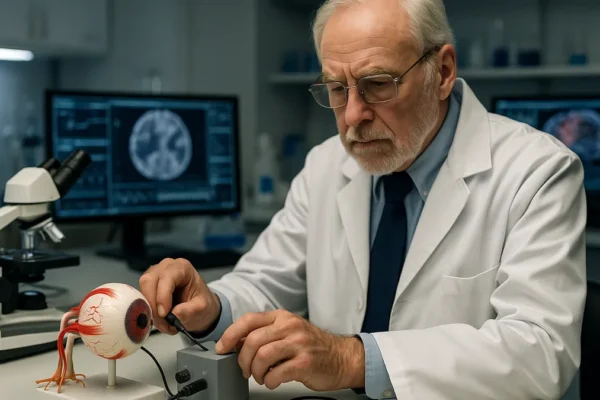
A researcher adjusts a neural stimulation device linked to an optic nerve model in a clinical lab setting with scientific tools and monitors visible.

Non-Invasive Electrical Stimulation for Optic Nerve Repair Is Advancing, but the Real Signal Is Still Trial-Defined

Non-invasive electrical stimulation is gaining attention as a possible way to support optic nerve regeneration, but the useful reading of the research is narrower than the excitement around “restoring sight.” The strongest signal so far is not that a treatment is ready; it is that externally applied stimulation may be able to influence axonal regrowth…

Read More
A diverse team of technology professionals collaborating around a table with laptops in a modern office environment.

If You Need Custom AI Behavior Without Losing Hard Safety Limits, OpenAI’s Model Spec Is the Real Change

OpenAI’s Model Spec matters because it is not just a private policy memo about model behavior. It is a public framework that sets a fixed instruction hierarchy, keeps some safety limits non-overridable, and still leaves room for developers and users to customize how systems respond in real deployments. The instruction hierarchy is the enforcement mechanism…

Read More
A diverse software development team collaborating around a table with laptops and notebooks in a bright office.

Engineering Teams Get More From AI When They Write Better, Not Just Prompt Better

AI coding tools are not fixing weak engineering communication; they are exposing it faster. The practical decision for teams is whether they already have enough written clarity, translation discipline, and architectural context for AI to speed work without quietly increasing bugs, rework, and technical debt. Who benefits from AI-assisted engineering communication Teams that already document…

Read More
A diverse group of people sitting around a table in a conference room actively discussing and using voting devices during an AI public dialogue event.

AI Public Dialogue Is Not a PR Exercise: What AI Café 2024 and Similar Models Actually Change

AI public dialogue is often treated as a way to explain technology to citizens after key decisions are already made. The stronger examples work differently: they let citizens, end-users, and experts interact early enough to shift opinion, define requirements, and test governance assumptions before AI systems or rules harden. AI Café 2024 in Luxembourg, participatory…

Read More
A spacecraft orbiting Jupiter with visible glowing radiation belts around the planet, illustrating the intense magnetosphere environment.

Cassini Changed the Risk Map: Why Jupiter Radiation Planning Now Depends on the Electrons Below the Peak

Jupiter mission planning is no longer based on a simple assumption that its radiation belts are just a larger, harsher version of Earth’s. For ESA’s Juice mission, the decisive shift is that newer measurements, especially from Cassini’s 2000 flyby, point to a more uneven and in some ways more dangerous electron environment than older expectations…

Read More
A group of AI researchers collaborating in a lab with multiple computer screens showing neural network data and AI models.

Google DeepMind’s AGI Framework Shifts the Debate From Bigger Models to Measured Cognitive Abilities

Google DeepMind is trying to make AGI progress harder to overstate. Its new framework replaces vague milestone talk and single benchmark scores with a structured test of ten cognitive abilities, then asks a stricter question: how those abilities combine, and how the result compares with demographically representative human baselines. Ten abilities instead of one headline…

Read More